

Bachmann 08 32-102
Bachmann 08 32-102

This coming weekend sees Railex 2015, at Aylesbury Bucks. One of the best shows of the year and consistently high quality. Aberbeeg will be there, an opportunity to see a large S7 layout with scale length trains. Also DCC sound being operated using ‘Touchcab’ and iPhones.
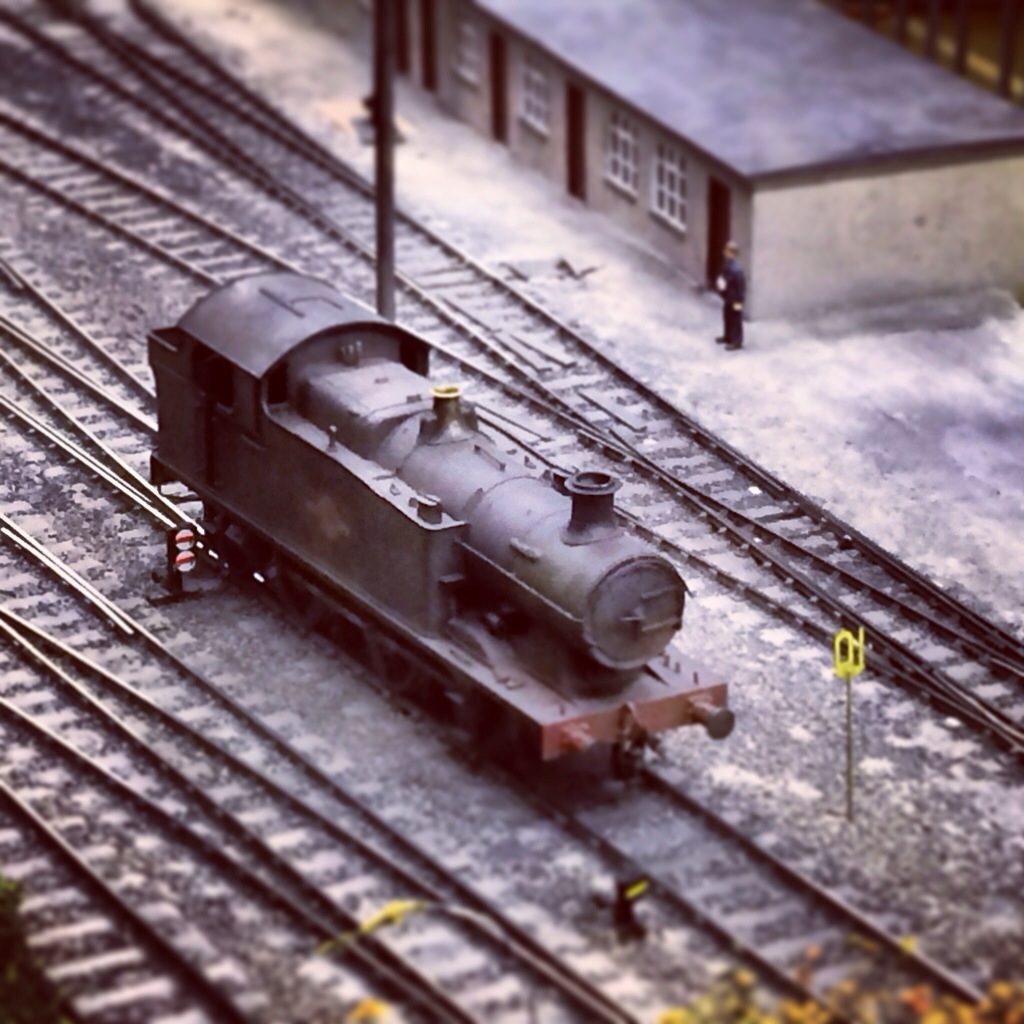

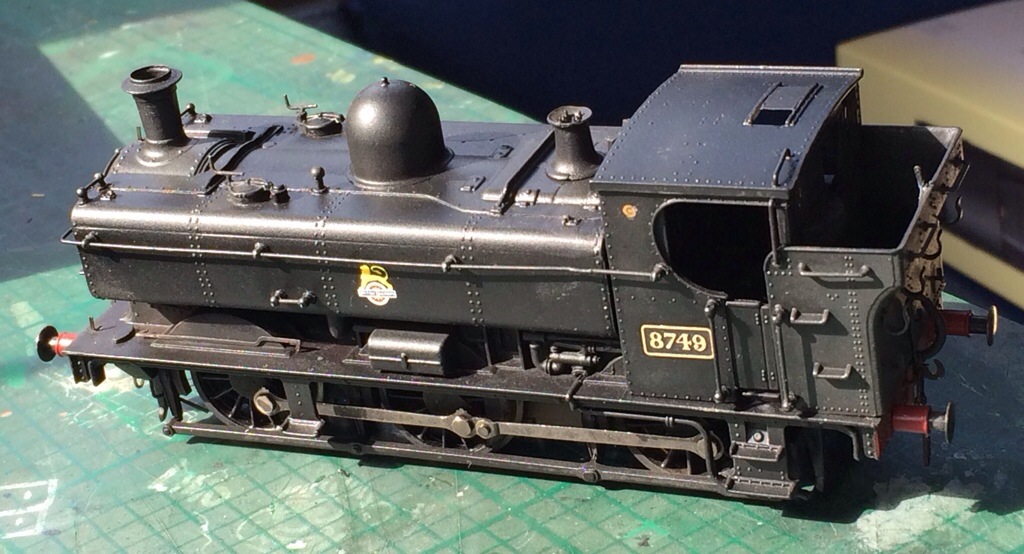
This past week or two I’ve been busy making an assortment of things from a 7mm guards van to 2mm scale figures. One of the more satisfying projects has been working over four Bachmann panniers. Here’s one of them, originally the Great Western version 31-635 it’s now converted to 6433 a late version of the 64xx class. More on these soon!

Bachmann 64xx 31-635 WIP conversion
Well having had a look recently at the 64xx, I’ve now started work on one of them to put it into the last batch of 6430 onwards, No 6433 in fact. The cab is the first bit and then its on to specific engine details. So far, so good.


Bachmann 64xx
31-636
In amongst the flurry of Hornbys releases over the first quarter Bachmann released their latest Great Western design, Colletts 64xx 0-6-0T Pannier. These were a derivative of the earlier 54xx, very much the same engine but with larger diameter wheels. Collett took the 54xx design and in essence reduced the driving wheel size from 5ft 2” to 4ft 7 ½” and changed a few other bits such as the cylinders and their dimensions. There were a few other dimensional differences, but as we’re not looking at the 54xx, the differences are somewhat moot.

Bachmann 64xx 31-635
A pair of 64xx’s have arrived, and I’ve been giving them a coat of looking at as Roy Jackson would say. Bachmann has chosen sensibly to do versions of the main batch produced with the detail associated with that group of locomotives. Color finish on them is excellent and I chose a green un so I can do some work on it in a future episode so stay tuned! Included in the box are lamp irons, vacuum pipes and screw couplings. The core dimensions of body and chassis are correct, with one noticeable omission. The main wheel splashers are too large which does draw attention to the wheels looking a bit too small for them. The Bachmann splasher encroaches roughly three quarters of the way into the space between running plate and tank underside, where it should be closer to half way.

Bachmann 64xx
31-635
Unfortunately with the chassis having the correct size wheels, sticking larger wheels underneath to make a 54xx will result in the body being too high, so there isn’t an easy way to a 54 just yet. Also missing is the lamp iron at the top of the smokebox and the grabrails above the running plate step. The handrails across the rest of the model are commendably thin, much finer than those on the larger Pannier produced from the same stable. Bunker steps and vertical cab rail are fitted on the firemans side, indicating a retrofitted fitted engine in Great Western days. At the smokebox the dart is a separate fitting, one handle is rectangular in cross section, whereas for service days they should both be circular cross section. Also missing is the steam lance fitting at the eight o’clock position as you look at the smokebox door. Tank steps are the later variety so we’ll have no cheeky renumbers before 6409 please, and the cab and bunker are give aways for suitable numbers before 6430. So, so long as you choose a number with a top feed, and the later hidden lubricators, i.e. as per this release you’ll be ok. No other numbers, you’ll get told off. For me disappointingly the buffers are rigid rather than sprung, I anticipate that being an easy fix. Also the top feed pipe routing is incorrect for pre preservation locomotives, and there’s no electrical conduit to the cab on the drivers side. Lamp irons on the bunker are moulded on, and the running plate has slots fo those included in the detail pack. Positions did vary from engine to engine though. Fire iron hook on the bunker are black, these will need painting green for green locomotives.
The body has typical fore and aft screw fittings to hold body and chassis together, and theres no difficulty in separating the two. This gave me an opportunity to look at the cab and its fixing. It will be an easy conversion for Bachmann to release a 74xx with the different cab and bunker shape. What it isn’t easy to do is separate without damage, the cab and bunker from the rest of the body.

Bachmann 64xx
31-636
The chassis is a typical contemporary Bachmann design driving onto the centre axle via a brass worm gear and nylon gear train. The core chassis block is metal and the axles run in brass bearings. DCC fitting is plug and play with a six pin NEM651 socket for a decoder. The design of the gear train allows quite a bit of play between motor and final drive, neither of these is as good a runner as my large Panniers and are on a par with Bachmann’s Jinty for running quality. The running is ok, and improves slightly on my DC feedback controller, but not as good as other similar models. On Albion Yard and its derivatives the running quality is a high priority for me. The body and chassis design look like there will be sufficient clearance for EM/P4 wheelset changes without significant modifications to any major components.
The fixer ..

Bachmann 64xx
31-636
The British Rail version seen here, was in fact the worst running ready to run locomotive I’ve ever had, with stopping and starting at random throughout the range of the motor speed. It was however an easy fix which I’ll add as a fifteen minute hero, as that’s all it took to sort.

Note right side pick up not making contact
Well I’d got two identical locomotives one running tolerably well and one, with no end to stopping and starting randomly. That usually indicates an electrical issue rather than mechanical and that’s what I targeted first. Removal of the body was straightforward, and a quick look across the wiring around the motor confirmed no loose or dry joints.

Bachmann 64xx
Chassis Keeper Plate Removal
The next quick check is the pick ups and this rapidly indicated the most likely source of the problem. The chassis keeper plate has six phosphor bronze pick ups, each bearing on the rear of the driving wheels. Each axle has side play, checking this and watching the pick ups, showed that on one side there was an occasion when two were not in contact, and the other side had two, and a variety of combinations between.

Bachmann 31-635
Adjusting Pick Up Angle
At no point were all in contact with each wheel face. Taking a set of tweezers I adjusted each pick up so roughly a 30 degree offset from the keeper plate. Not the best image below but note the offset of the pickups. this is immediately before fixing the keeper plate back on.

Bachmann 64xx
31-636
Once the keeper plate was screwed back on all pickups were in contact with the wheel surface and running was properties were identical to the other chassis. If that adjustment hadn’t fixed it, I would have suspected a faulty motor, and returned the model.

Bachmann 64xx
31-635
I think the 64xx’s represent good value for money, the model in most instances is accurate and captures the appearance of the prototype well. It depicts the main detail matches for the majority of the class so a renumber is a realistic prospect to get the locomotive you want. If the market stands it the design of the superstructure looks like the 74xx could be a later development of this model. For me these two are going to suffice for Albion Yard stock once I’ve given them makeovers. The 64xx type wasn’t widely seen in the Forest of Dean, but they did operate around Gloucester, and the Wye valley to the west so as occasional visitors they’ll work for me.
bachmann 31-635 GWR 64xx
bachmann 31-636 BR/WR 64xx

Hornby J15 R3232
One of the latest items released by Hornby is the Great Eastern Wordsell designed Y14. The type first entered service in 1883 and was reclassified to arguably its more common designation of J15 after Grouping by the London & North Eastern Railway. The model as received depicts one of the class in their twilight years with the British Railways late crest, the subject locomotive being withdrawn in March 1963. The class was popular with both crew and enthusiasts. With a light axle loading the type was suitable for use on the light branch lines of East Anglia, for example it’s easy to locate images of the class working the Snape Maltings branch in Suffolk.

The model I’ve been poking and prodding is the OO 4mm scale late BR logo J15 R3232. It is supplied in the contemporary packaging of a vacuum formed protective cover which fits inside a cardboard tray with an outer sleeve. The locomotive was well protected and no components are loose or have suffered any damage in transit.
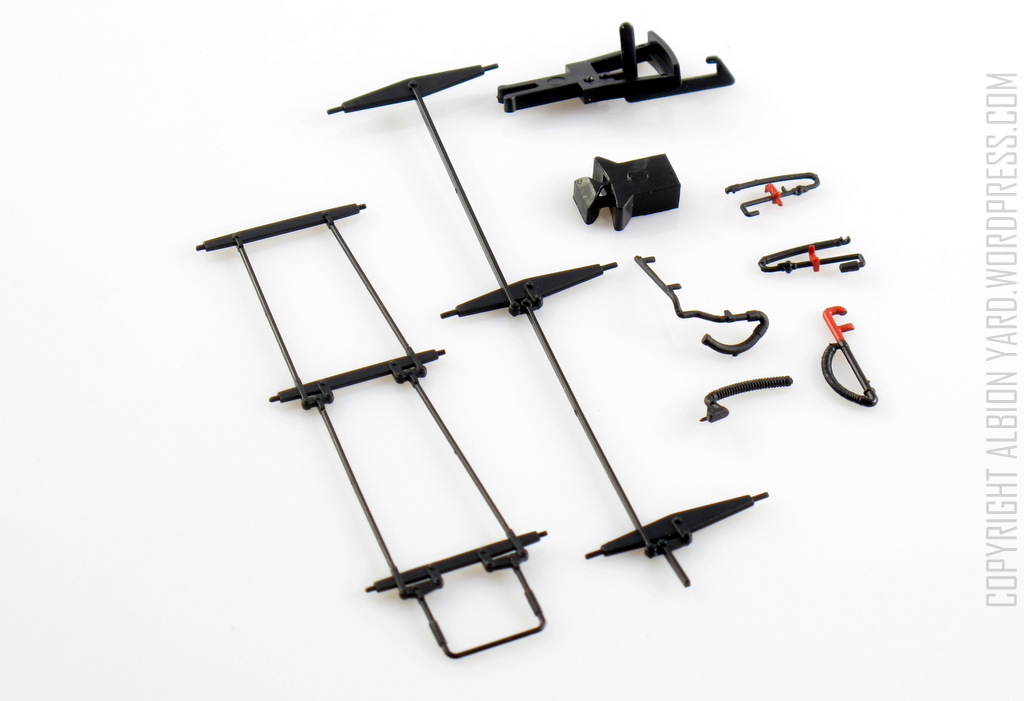
Included in the packing is a detail set including brake pull rods and the locomotive front coupling. Despite the models small size it weighs in at approximately 185g for the locomotive, the chassis block, footplate and boiler being metal castings. An additional weight is provided within the tender.
First impression often counts for me, and the J15 doesn’t disappoint. It immediately looks in proportion, edges are well defined and thin, particularly the cab roof and the color is a good opaque dull black with a very slight sheen to it. There are no paint blemishes and the detail printing is legible and clear. Like the K1 reviewed earlier on the blog, the yellow numbering looks to me a little too far towards a ‘lemon’ shade rather than a more cream color which I feel is correct. The wheel tyres and coupling rods are a pleasing steel color rather than bright chrome which blighted models in the not too recent past. Detail fittings are all correctly fitted and square and no evidence of excess glue around them. The prototype over its many years of service underwent a good number of detail changes. For the late livery as supplied it appears that Hornby have all the variations correct on this model and cross checking my available drawings the dimensions are correct too. The locomotive superstructure reflects the late chimney and dome in the forward position. Handrails reflect later era fittings with a continuous handrail above the smokebox face. Boiler mudholes are correctly offset on both sides of the engine and smokebox door is has the bevel edge and seating ring around the circumference. Smokebox dart is a separate fitting as are the lamp irons. The cab is represented with the later replacement steel plated roof and the cab sides the later smaller cut out. These are easily identified by the pronounced bowed effect of the cab profile and for the cab sides the tender rail and cab rails being of matching height.

Looking at the assembly of the superstructure components the join lines all indicate that if in the future Hornby want to backdate the model to an earlier Great Eastern or LNER version that will be possible. Cab detail is delicately modelled with separate fittings, the screw reverser aligning perfectly with the external rod to the mechanism. In front of the off side cab sits a Westinghouse brake pump which is well proportioned and crisply moulded.

The chassis is an interesting piece of model engineering. In terms of detail, it matches the superstructure above. Below the firebox on the right hand side you can see the strengthening plate and Westinghouse pump drain. Brake shoes and pull rods are moulded in plastic and are correct shape and size. Wheels on this particular locomotive have balance weights as they should, for a ‘last forty’ batch engine, and non fluted coupling rods. Both locomotive and tender have the correct number of spokes ad profile wheels. The top of the chassis shows a representation of the inside valve gear and the underside of the boiler, allowing full daylight to be seen through the locomotive.
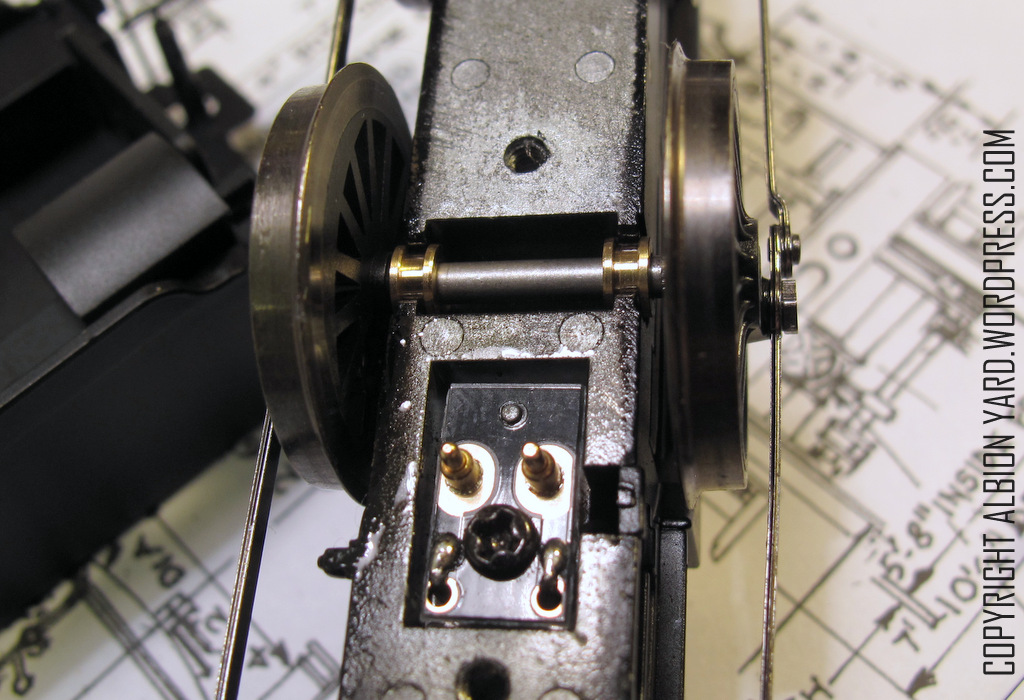
The chassis core is a metal casting with a plastic keeper plate that has phosphor bronze wiper pickups bearing on the rear of the tyre. All were in contact and the locomotive runs very smoothly through its full speed range without hesitation. The axles sit in circular brass bearings within the chassis block. The drive is to the rear axle, this is quite a challenge with a small open cab locomotive for it to remain hidden. The motor sits in a cradle which is the underneath of the boiler, and is fitted with two brass flywheels on extended shafts either end of the motor. Drive to the rear axle is taken via a plastic drive shaft to a gearbox tower that sits within the locomotive smokebox. The tower converts the drive via gearing to a plastic final drive gear to the rear axle, with all the mechanism enclosed within the chassis block, (more on this later). There is lateral movement of all axles though not excessive and clearance on the insides of the running plate splashers too. I’ve not measured it but my feeling is that the current chassis and running plate would likely accommodate an EM/S4 conversion with little (if any) modification.

All wiring is tidy and accurately soldered, another neat touch being the channel within the chassis for the wiring loom from locomotive to tender. The tender coupling has two positions to allow for normal operation and close coupling for display or gentler radius curves. I’ve had no issues on 36 inch radius curves with the close setting used.

The tender is correct for prototype and era. Like the locomotives they underwent changes throughout the life of the type. In terms of detail the tender shows the same degree of finesse and accuracy to era. Tender frame cutouts are correctly oval as opposed to ‘D’ shape on earlier engines, and the brakeshoes in line with the OO whelsets. The Fire Iron shield with the holder is in place as are external curved coal rails and the water gauge, all appropriate to the era portrayed. The brake cylinders for the Westinghouse pumps have been omitted; these are unlikely to have been visible and would probably have fouled the electrical connection between engine and tender. The molded coal insert for the tender is removable and shows the peculiar rectangular spaced coal bunker underneath, no gravity assistance for the poor fireman here!

The tender houses the 8 pin DCC chip blanking plate. The tender floor has slots which if fitting sound will help with the acoustics. Space is limited however and a sugar cube type speaker would seem a probable choice if fitting sound, and possibly the removal or reduction in size of the tender weight will help.
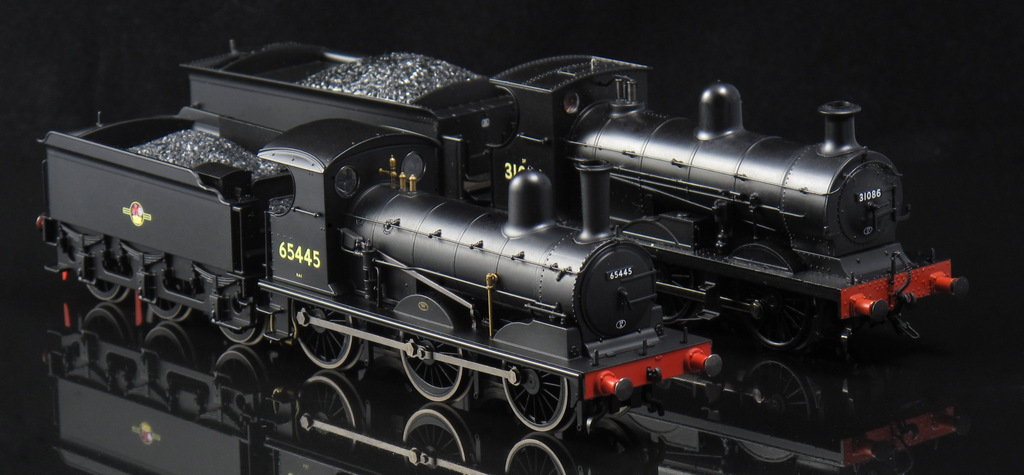
Whilst looking at the chassis of the J15 I wondered how it compared to a typical Bachmann product of a similar nature. In stock I had access to a Bachmann 3F and ‘C’ class. As the ‘C was more recent I thought it’d be interesting to see them side by side. As far as the prototype goes they were similar designs of similar sizes for similar work. Clearly this is not a true like for like, but interesting in looking at how the models differed.

Paint finish is excellent on both as are the lettering and logos. Hornby has a matt finish and the Bachmann, satin. In terms of detail the Hornby model has the edge in terms of finesse, in general lamp irons and small details are finer from Hornby.

The J15 tender chassis has brakes in line with the wheels where the ‘C’ class are integral with the outer frame. This doesn’t sound much but when seeing the two side by side there is a noticeable difference, but nothing a bit of old fashioned modelling can’t sort out for Bachmann’s ‘C’.

The loco chassis is the most interesting though. Bachmann choosing a centre axle drive and an enclosed motor, the model runs well and with this prototype Bachmann haven’t encroached into the space underneath the boiler. With the J15 and the smaller firebox Hornby could also have taken this ‘easy’ route, but have come up with an excellent design keeping the motor and mechanism hidden. The running properties are slightly smoother than Bachmanns, no doubt aided by the double flywheel. Both models have similar connections between engine and tender, but no close couple option from Bachmann. The tidy wiring from Hornby also being of note in this context too. The Hornby configuration has a good number of possibilities for small prototypes, length reduction can be achieved with one flywheel removed and a shorter cardan shaft to the gearbox.

For interest I placed a 14XX next to the J15 chassis. The current motor, gearbox and flywheel configuration would all work in a 14xx chassis with no cab encroachment. With quality cast superstructure like the J15 and a metal chassis with the metal boiler motor cradle, the possibilities for future development of detailed and well running smaller locomotive prototypes is intriguing indeed.

Overall then, a very competent and pleasing representation of the J15, to a high standard of finish and detail. Being the follow on release after the K1 the J15 keeps the same standards and possibly with the chassis and motor engineering, exceeds them. If these standards for toy train sets are kept this high we’ll be thoroughly spoilt. And frankly, why not?
Hornby R3232 J15 DCC Ready
Product ref LOT01-P91569
R3232-03-078
This is one of the few times I’ve felt the desire to reblog something, this poem ‘Riding Strange’, a train ride, took me back to the first day I was involved in the toy train ‘industry’. This was me, on the train to Kings Cross and first ever job interview to work in MRM at the cross. I got the job, some say from then on it was downhill all the way … https://norvenmunky.wordpress.com/2011/01/02/paradise-city/
Riding the train to Osterley,
The cuffs of my shirt dig in,
Unsettled and weary of the
Unnatural position I was in.
This strange crisp shirt,
This odd little tie,
These awkward lapels,
These ankle biting shoes.
It was all very strange for me.
Was I wearing it right?
Did I look the part?
Or were my trousers too tight?
Around me were strangers,
Dressed for once, like me.
As if in solidarity
Of my very own journey.
I sat back and observed,
How that person was wearing his suit.
How that man was tying his shoes.
And I wondered If instead, I should have
Worn my black boots.
Tiring and terrifying,
This importance of appearance.
But this journey that I was on,
Oh, I loved that.
Or, end of the beginning? Simple answer is I don’t know. This was one of the pieces that never really hung together, so it’s gone.
On that bombshell …


You must be logged in to post a comment.