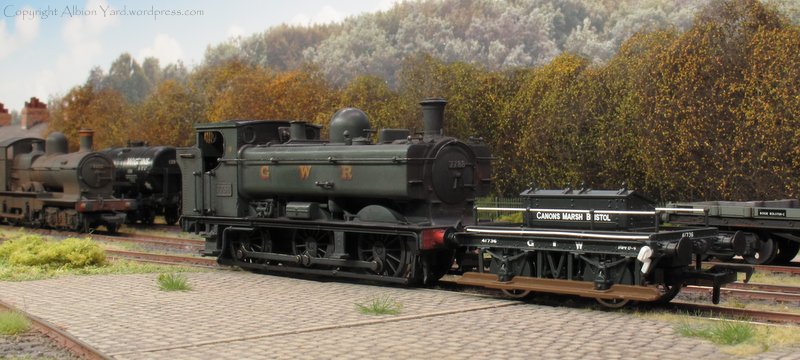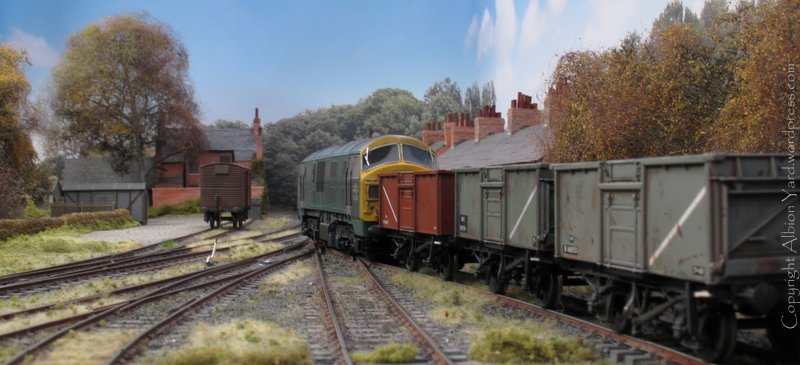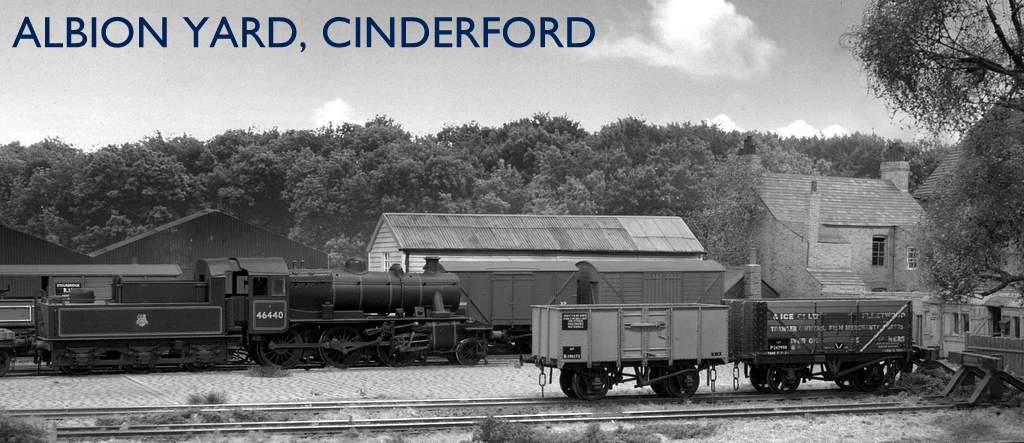
Warley & The Digital Backscene

b6o4472-cr2This weekend is the final show for the layout, and we are stand B50 at the NEC Warley show. One of the main features of the layout is the backscene, which is a digital print. It is one of the items as well as trees and fiddle yard that I get asked most about. So, this is a quick story of the backscene.

Some of the biggest challenges that layout builders have, particularly those that exhibit layouts, are to do with the transport and presentation of the layout at shows. One of the key choices to make is about the back scene, whether to have one, and if so how to go about the production and presentation of it. Not everyone feels the same way of course, I was recently sent this quote about Albion Yard, I’d not seen it before, from one of the hobbies foremost bullshitters, sorry ‘experts’.

Hiding is easy on a plank size layout with a limited service but a big roundy roundy with lots of trains moving presents a lot more issues, as Tims photo (above) shows, it takes enough work to make the layout without having to spend as much time hiding the fiddle yard

I’ve always felt that a back scene was a critical element of a layouts presentation, so rather than just following our Guru’s mantra of nailing pieces of hardboard covered in white paint, heavy emulsion brush marks, and backscene joins provided by ‘The Bachmann Trencher’, (you wondered where he’d gone? Alive and well working in the North West apparently)’ I did something different. Rather than staying in the 1970’s, as the group above clearly feels is the way forward, I spent a good deal of time looking at how the layout would appear. I wanted it to look plausible and have depth, rather than something from the flat earth society. It takes no more effort to make a layout look good than bad, it can take time of course, and size doesn’t have much to do with it either, if you use the right commercial printer you’ll run out of a single ream of material before you run out of layout. One critical element our guru missed, and which shows he has no knowledge or experience of making decent scenery and backscenes, is the fact that with smaller layouts making the scenery and backscene integrate effectively is far harder on a small layout than it is on a big one. He won’t know this as he’s never done it, but its because you have less room and the backscene is closer to the viewer!

Previously my layout was in a room with a neutral off white wall colour a natural back drop, now the layout was free standing I felt it needed a plausible back scene.
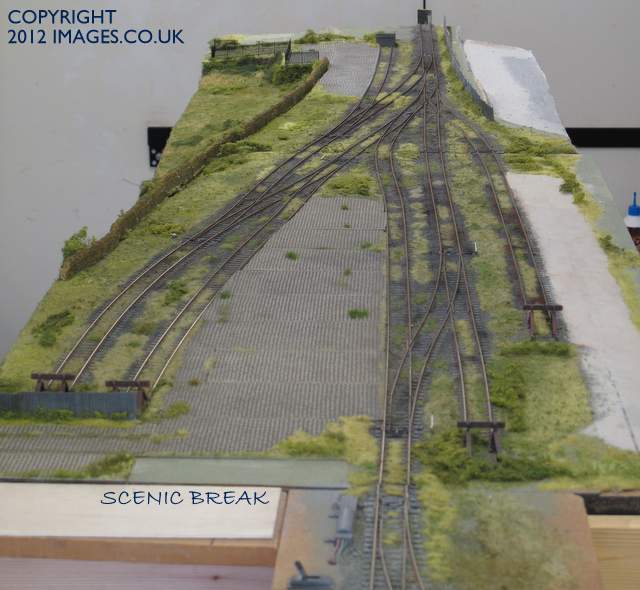
Track layout looking from fiddle yard.

Track layout looking from fiddle yard.

The layout is three separate boards, no different from many other layouts. I’d always been impressed with layouts such as Barry Normans ‘Petherick’, Iain Rices ‘Woolverstone’ and Peter Kirmonds ‘Blea Moor’.All of these had backdrops, Petherick was unusual as it had the whole display thought through including fascias and lighting, for its time, I believe it was unique in this aspect. Woolverstone and Blea Moor had material back scenes so I was heavily influenced in presentation by these three layouts.
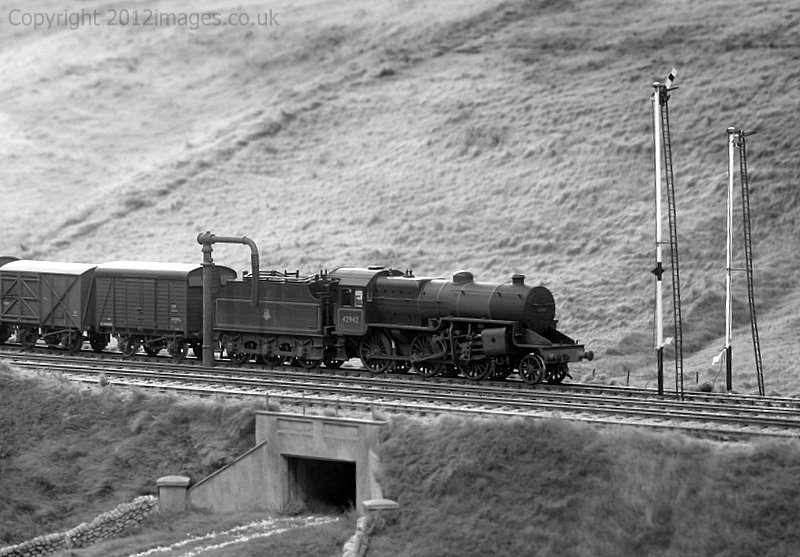
 Blea Moor By Pete Kirmond

Blea Moor
By Pete Kirmond

The other layout I’d been fortunate to watch develop was Chris Nevards ‘Catcott Burtle’ http://nevardmedia  where he had used a digitally printed back scene attached to a rigid one piece backing. I had messed around with some commercial photo back scenes but wasn’t very pleased with them. The join was very difficult to hide as was getting them fixed without any ripples. The colours on the images were also too dense and not balanced to the foreground model.
From all these influences I came to a simple conclusion. What I needed was a creaseless, seamless and detachable back scene, about 16 feet long and matt finish. That was the easy bit, the next part was where to get it from, and what material to use. I’d determined the layout would be set in the Forest of Dean, so any image on the background would need to reflect that in some way. So my two criteria were now a seamless backdrop, depicting the Forest of Dean. The digital printing option seemed to hold the most promise, but whilst that was the final outcome it wasn’t an easy journey.
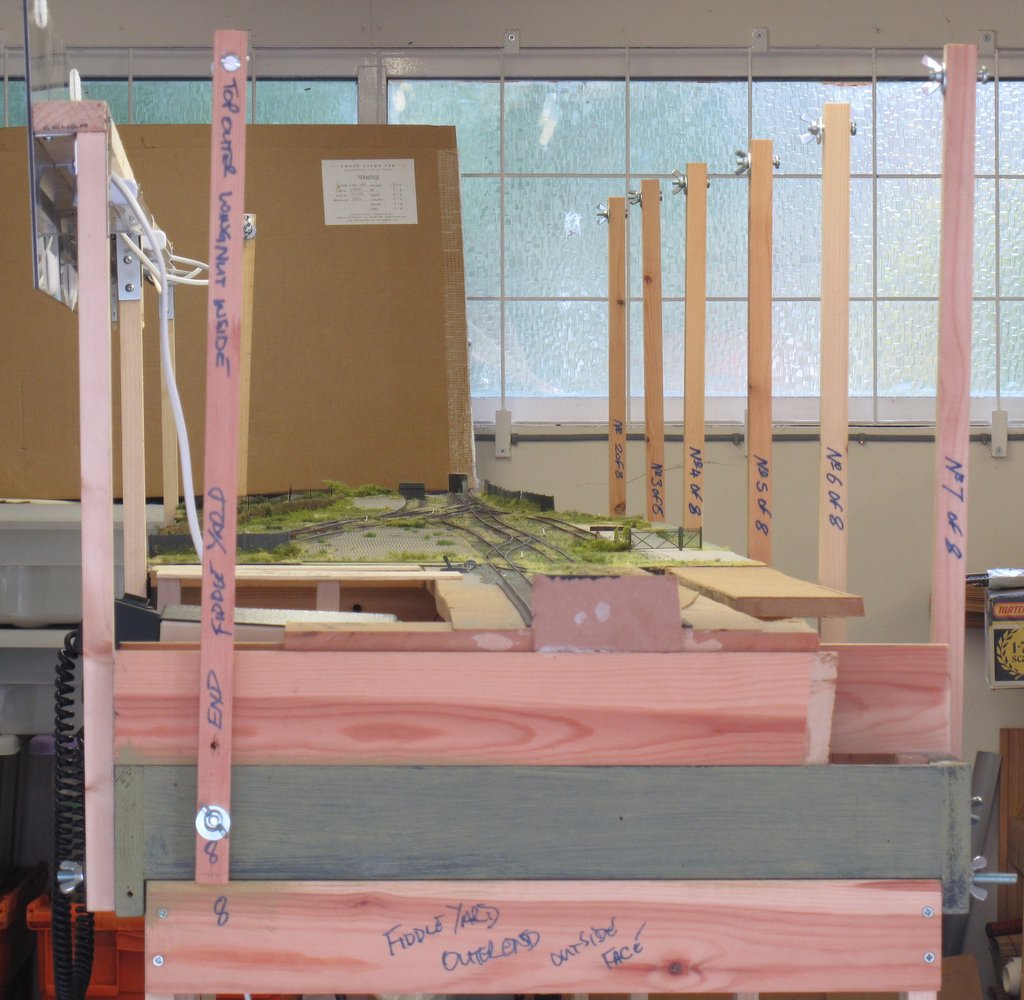
Basic hanging framework on the layout chassis

Basic hanging framework on the layout chassis

Most high street commercial printers have a variety of materials they can offer, but it took a while to find what I wanted. I worked out that to get a durable print with a degree of strength and thickness a commercial material should be where to start my search. The first break though I had was looking at curtain side truck canvasses. These had the strength and rigidity I wanted but as the cotton used as a strengthening weave showed though, there was an unwanted texture that would be visible. I’d almost exhausted the local printers in that none of them had the right material for the print, for the most part they were too glossy and thin. By chance I was visiting a friend and on the way passed a print shop at the roadside. As I had a few minutes spare I popped in to see what they had. It very quickly turned out I’d found the right place. John, the printer, was asking all the right questions, and didn’t seem surprised when I told him the application for the print. This was because in the past they had worked on theatre backdrops, so I knew we both had the same understanding of what I wanted to achieve. We quickly found in stock the material that had been so hard to locate, it’s a product used for exhibition displays and can roll up like a slide projector screen. It was matt white in finish and had a medium grey opaque backing. John showed me that it could have eyelets attached to it so I could hang it from a structure on the layout, which met the detachable criteria. So that was sorted, next job, the image!
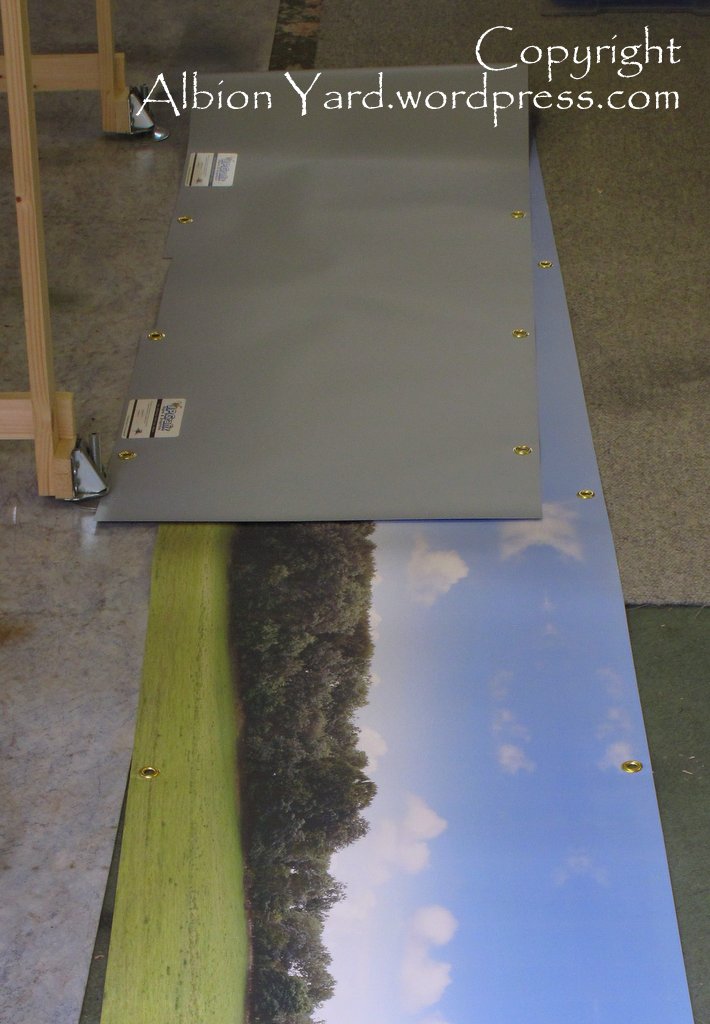
14ft of digital print prior to installation

14ft of digital print prior to installation

I’d been speaking at length with photographer and modeller, Chris Nevard, we both have similar ideas about layout presentation, and he kindly offered one of his images for me to try taken near Priddy in Somerset. It was a large panoramic image of a tree lined field which we worked out would stretch half the layouts length. It was taken on an overcast day so we mirrored the image and there’s very little in the way of visual clues in the shadows to see that’s been done. The greater majority of photo back scenes have too much contrast and this shows by making the back scene overpower the foreground, this then creates a visual imbalance and is as noticeable as a vertical join line.
Chris has done a little photoshop work on the image, adding a different sky and some blue tint over the whole image, this isn’t really noticeable just looking at the image but adds distance and depth by reducing contrast. You don’t need the range of digital skills that Chris has, many good printers will be able to help here, John, my printer was able to do some last minute digital adjustments before we went to print.
I’d now got my back scene image ready, and we printed the first test piece. I’d taken a small diorama I use for photography and a black locomotive to try in front of the test piece. The first result was a little disappointing, the colour being too dense, so we tried a couple of different test prints until I was happy that the colour density of the backscene matched the test diorama, when it did we were able to print the entire image.
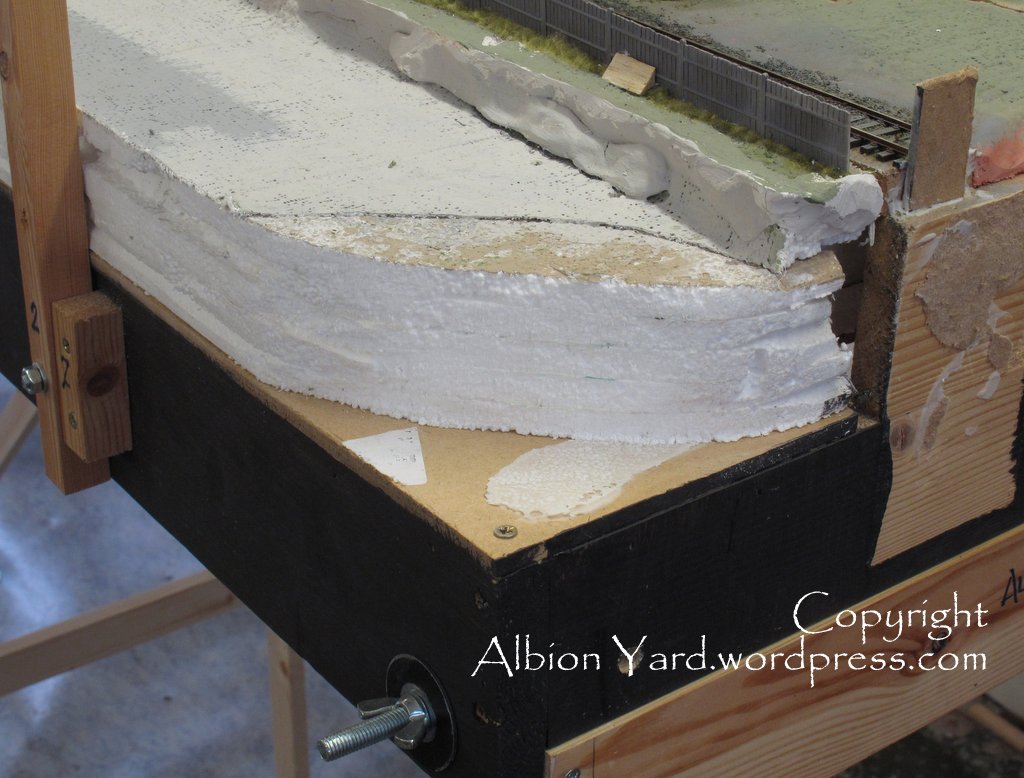
Cutting scenery to ensure no square corners in the sky!
Cutting scenery to ensure no square corners in the sky!

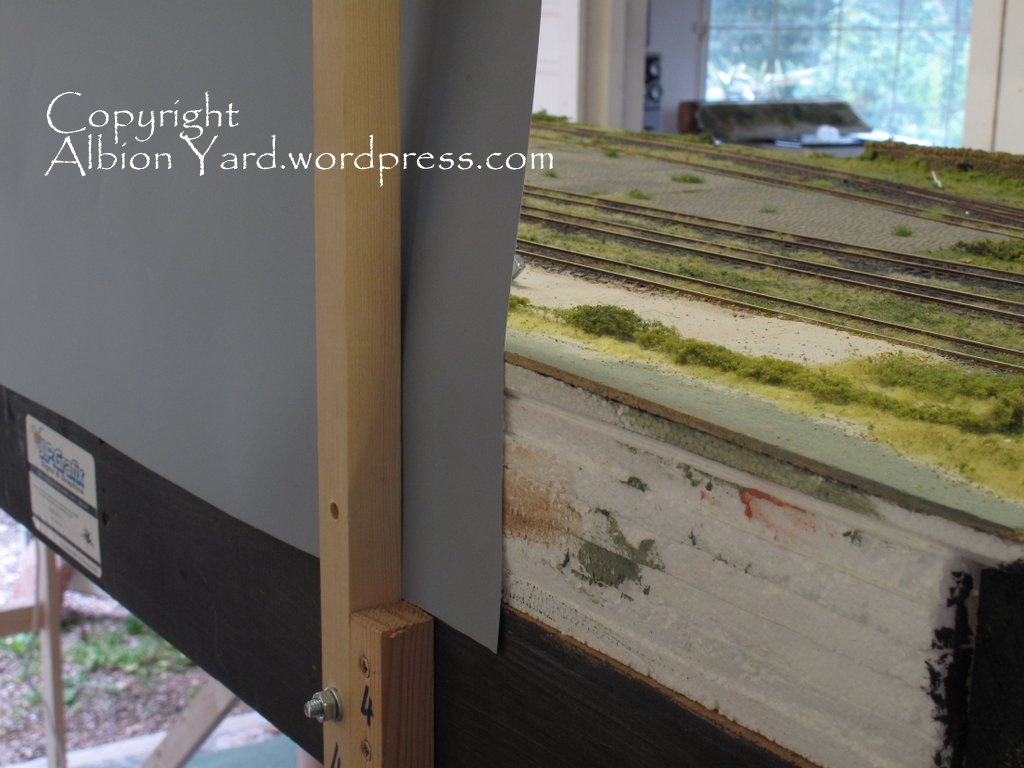
The stantions sandwich the print between baseboard and support

The stantions sandwich the print between baseboard and support

Whilst the printing was carried out I still had to work out how to mount the final image. As John was inserting eyelets for me he needed to know where to put them. The image would wrap around three sides of the layout, so I divided it up into 60 cm spacing making sure none of the eyelet alignment occurred at baseboard joints or at structural beams. It took a while thinking of all sorts of contraptions but the simplest idea once I got it was the easiest to install and make functional. I made detachable stations out of 2cm square stripwood leaving the layout looking like an empty bogie bolster without the back scene. Keeping them vertical was simple, they butt up against an alignment block fixed to the layouts side.
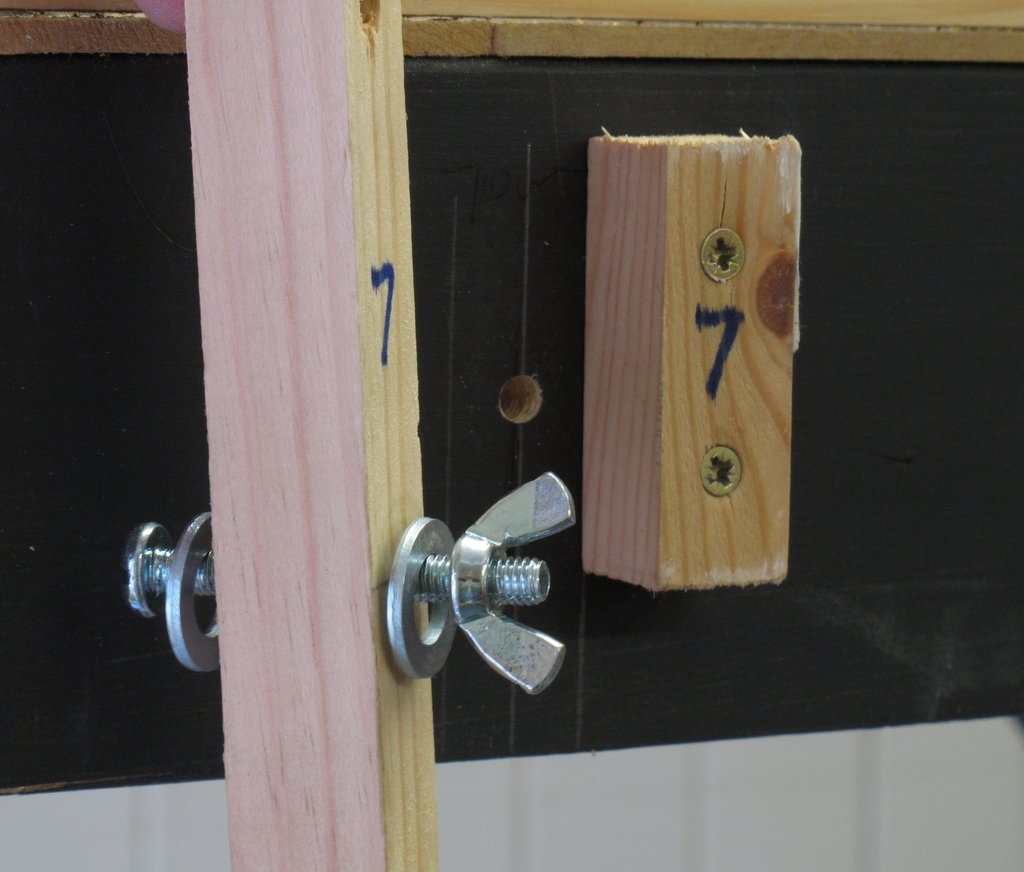
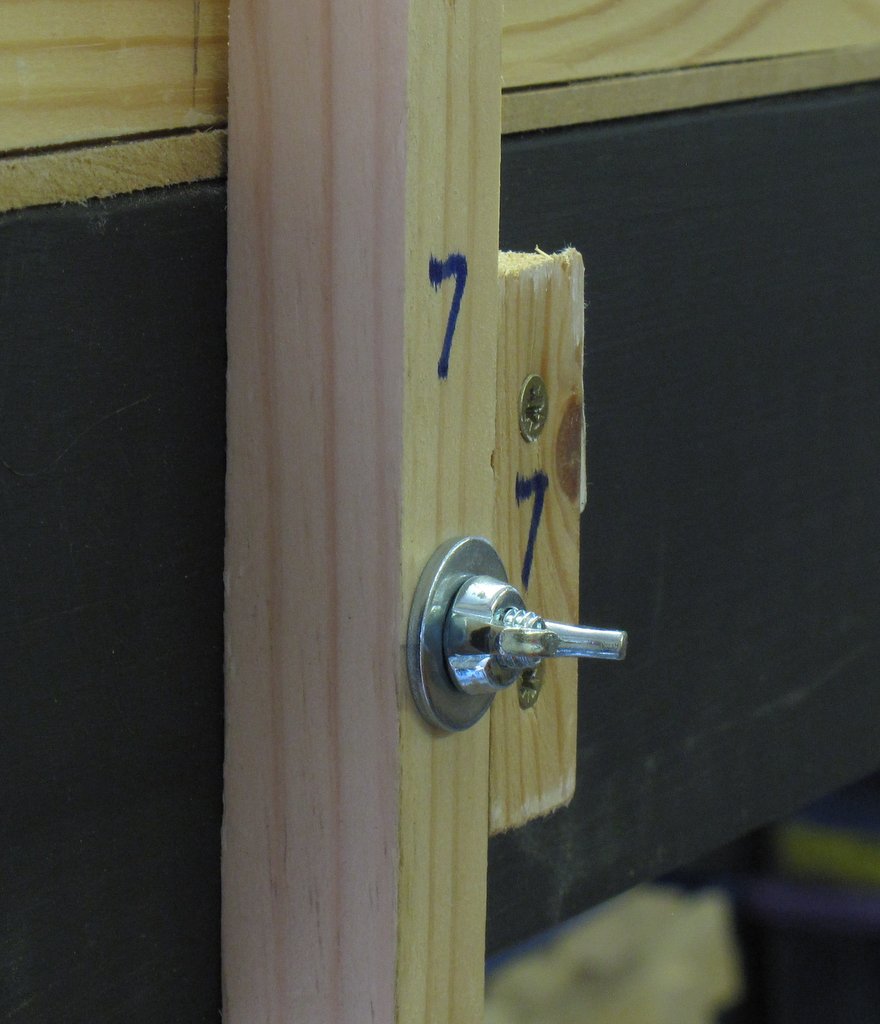
IMG_8880IMG_8882The top mounting for the image was a simple coach bolt, penny washer and wing nut. When the image came back from the printer the first trial was really interesting. The eyelets worked as I intended. The image can be unrolled and loosely fixed one station at a time. Even when it’s loosely hung it makes an astounding difference to the overall appearance. I started at the middle of the layout tightening each coach bolt as I went. The coach bolt is a smaller diameter than the eyelet, so on each station there is vertical and horizontal adjustment available along the entire layouts length. This allows the back scene to tighten and removes any waves or ripples that are there before tensioning. At the corners the material naturally curves around whatever former you choose, immediately removing the square corners so often seen on layouts be they home or exhibition based.
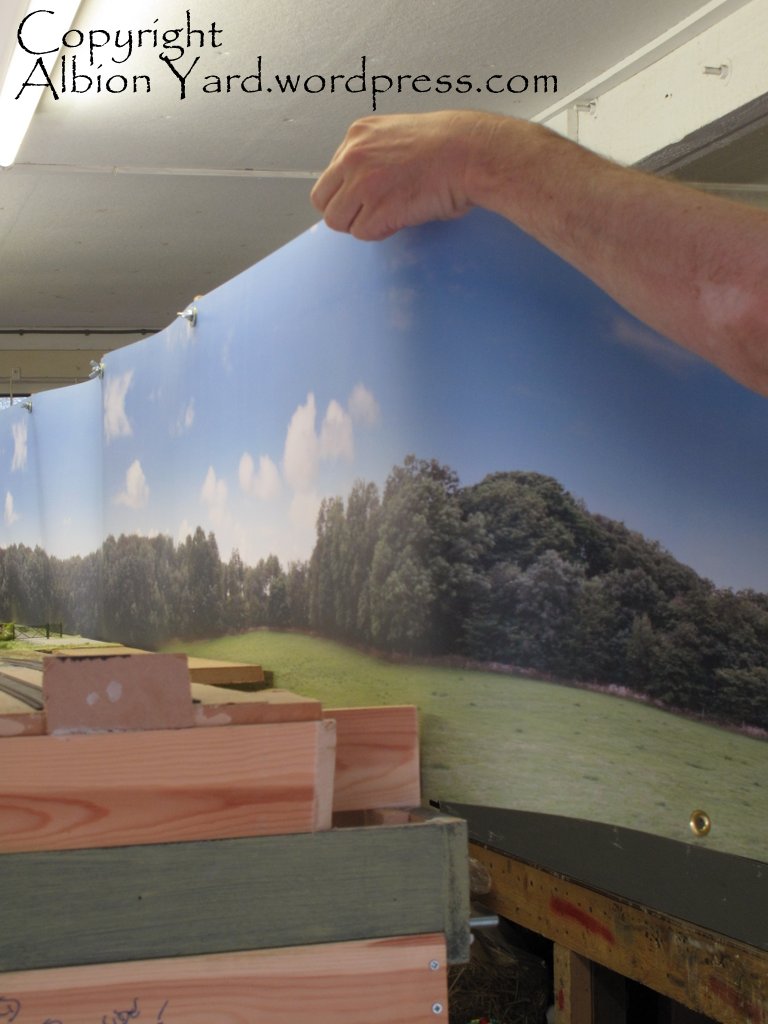
Installing the backscene

Installing the backscene

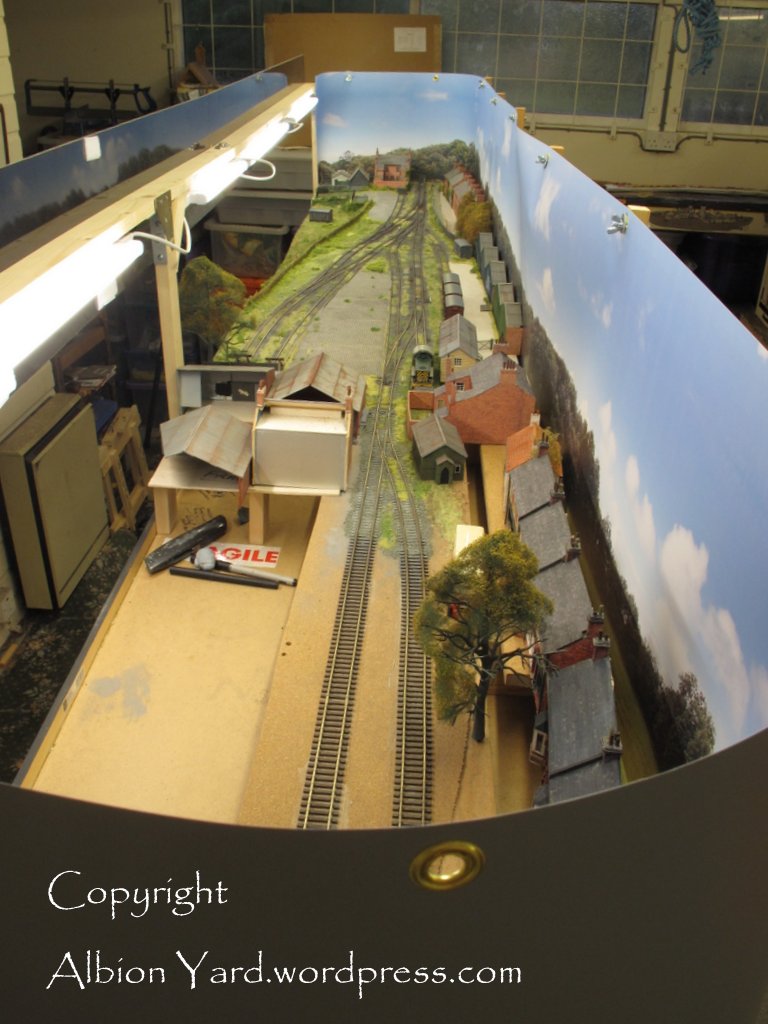
The layout back scene is an elongated U shape and final fitting can be made trimming the edges of the image to suit your requirements, the only trimming I did was at one corner to allow the images to sit level on the baseboard. I then designed my fascia to join the ends of the layout and image, making a letter box view presentation.
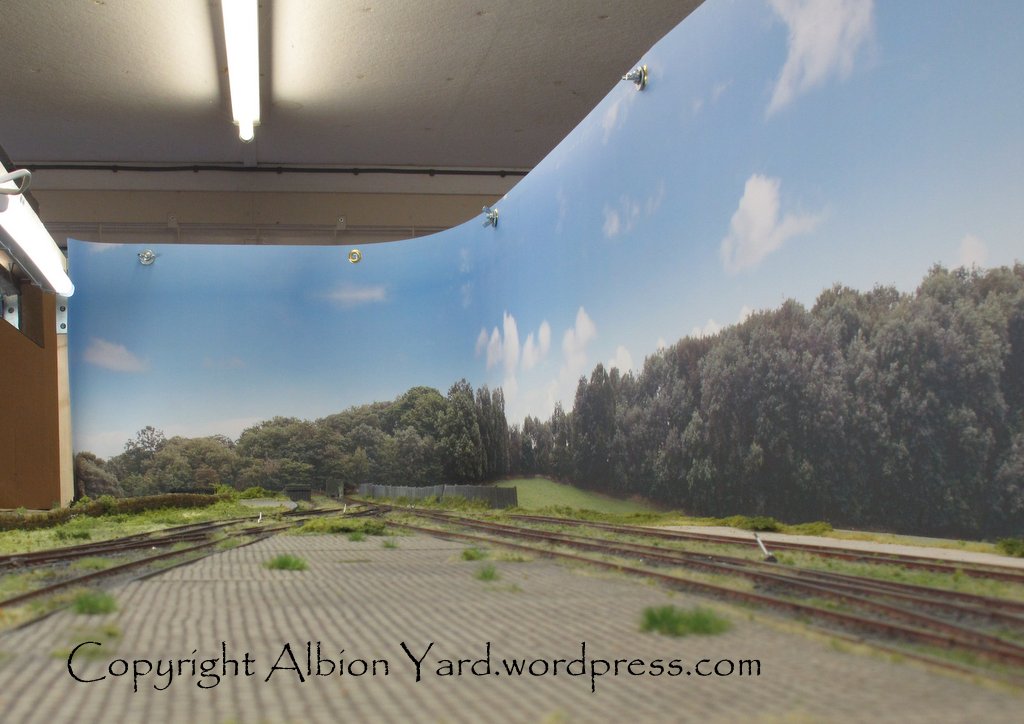
From the inside, note little shadow on backscene
From the inside, note little shadow on backscene

Overview of installation and fascia's fitted

Overview of installation and fascia’s fitted

As the layout is operated from the front the fiddle yard is view blocked with a simple curtain which can be accessed when trains are required to be changed. The lighting units are fixed on the rear of the fascia and are simple 20w kitchen under lighter units, these are powerful enough to light the whole layout and the back scene bounces light back onto the model giving an even light across the whole scene. Once I’ve built the layout structure, I then place buildings and scenic accessories as required, I can change some of these around too subtly altering the appearance if I wish to.

One thing I’ve not mentioned so far is the cost of the project. Including materials, printing and manufacturing the whole back scene project cost approximately £175, which may seem a lot. However its less than the cost of many DCC sound locomotives, but gives a superb one piece seamless back scene, customised to your specific layout. Is all this too much hard work? I don’t think so for the ultimate effect it has on the overall appearance of the layout. If you come to the show make you look at the layout from the left hand end, this is the point where the backscene, view blocking and hidden fiddle yard comes into its own, and you get the ‘long view’. Judging by the positive responses I have both on line, but more so when people see it at shows, it really does make an impact. The ladies seem particularly taken by it, so if the traditional route of flowers or chockies isn’t working for you, show them your back scene!

Don’t forget of course that this is a hobby, it has far more nice people in it than unpleasant sciolists. I hope at the weekend to see plenty of the nice ones, rather than those who are as thick as two short shunting planks.

_B6O4719.CR2

Posted in Bachmann, Branch Line, British Rail, canon, Chris Nevard, copyright, Eastern Region, Exhibition, Forest of Dean, Great Western, hobbies, Hornby, Ian Futers, Kalmbach, Layout, LMS, LNER, Manchester, Midland Region, Model Railroad, Model Railway, Model Railway Journal, Modelling, Nevard, OO Gauge, Photography, Railex, Scottish Region, Southern Region, Uncategorized, Welsh Marches, Western Region | Tagged , , , , , , , , , , , , , , | 8 Comments

The Canadians are coming!

IMG_2040

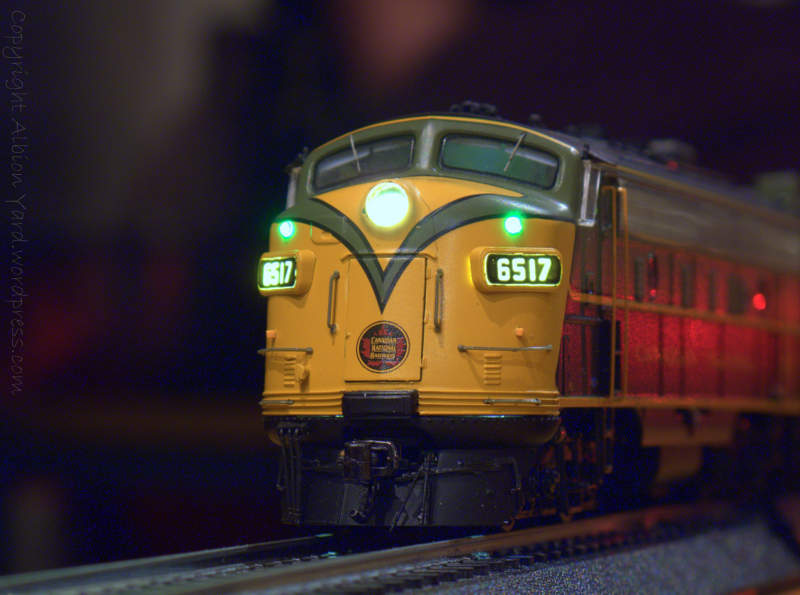
Just a quick update, yesterday, after an interesting drive across the top the pennines,  through snow and snow showers, I and some other enthusiasts were treated to a presentation of the Canadian Company Rapido, Jason Shron was a very engaging and open presenter discussing the company, its Canadian prototype products and its hopes for the UK market and future. On one forum it took three pages before someone realised that the presentation wouldn’t involve releasing what’s coming to the UK market, so at least one enthusiast is on the ball. The UK market had better get its head round the Rapido production ethos. They make a number of product X, and that’s it. There’s no point saying I’ll wait to see what they are like and then buy one, if they make what you want, order it, like Nike says, ‘Just do it’. If you don’t order one you won’t get one. I’ve found that out to my cost with a Canadian product they do, its taken a while to find one, and its at, (sit down now and take a deep breath) full retail! Oh, and they have no intentions of being the cheapest in the market either, and for the quality they provide that’s exactly the right mindset for them and their customers. The Canadian market took a couple of releases to get this supply/demand chain into their mindset, I’m already on board, and if you want what they are going to make, place your orders as soon as possible.

IMG_2034-001

I’ll return to this in a future blog post, one thing is for sure though and that’s they are already here, anyone with a sharp eye can already see the mark of the ‘True North‘ in a UK Product. One of the clues is out there …

http://rapidotrains.com/

_B6O4719.CR2

Posted in canada, canon, DCC, dcc sound, Eastern Region, Exhibition, Great Western, hobbies, Hornby, Kalmbach, Layout, life, LMS, LNER, media, Midland Region, Model Railroad, Model Railway, Model Railway Journal, Modelling, Nevard, OO Gauge, Rapido Trains, research, review, Scottish Region, Southern Region, Uncategorized, Western Region | Tagged , , , , , , , , , , , , , , , | Leave a comment

Business as Usual

Oil Burner 3711

Oil Burner 3711

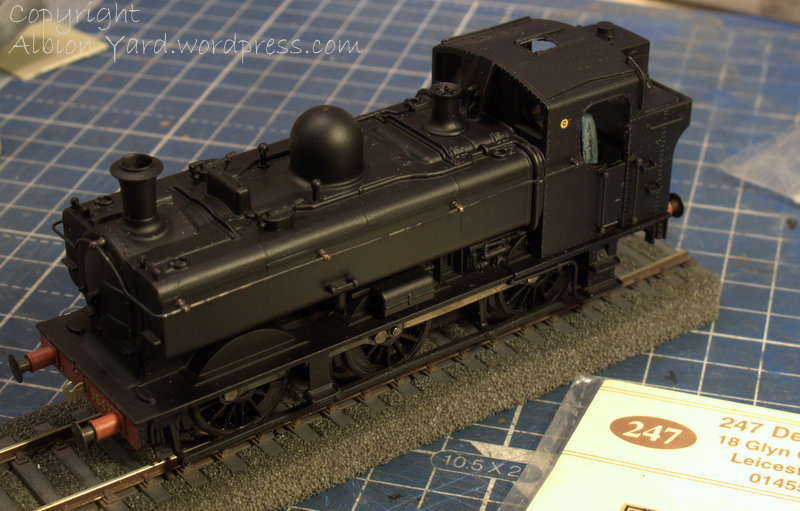
Business as usual, being messing around with Panniers. Warley is this coming weekend and it’ll be the layouts last showing in public. I usually try and do a couple of new items, usually rolling stock or motive power, and this is the new arrival for this weekend. I tend not to bend the rules to ‘Its my trainset and I’ll run what I want’ at shows, keeping the layout pretty firmly established in its late 50’s to early 60’s time frame. With that theme I also tend not to have ‘guest’ locomotives or stock, staying with the art of the mundane rather than going for the ‘glitter monkey’ shiny, shiny, specials that some layouts run. This weekend I wanted to add a bit of a change, and to this end I’ve mocked up pannier 3711 which was converted to an oil burner in the late 1950’s. The loco stayed in the Swindon Paddington area, and was thought to be a successful and powerful conversion. By the time the loco was in service the cross over between steam and diesel was well underway, so the writing would have been on the wall even then, for any further conversions. It isn’t an exact replica, I’m still hoping to get drawings or better photos of the engine to make a more authentic conversion, however it captures the look, and for the last show, it’ll be nice to add a little variety, with the loco ‘on trials’ out of Gloucester.

Last year I wrote on return from Canada about a band I’d seen out there, Dawn & Marra, playing at  Hamilton’s Festival of Friends http://Canada-post/  I’m pleased to say they appear to be doing as well as I thought and hoped they would, Scooping the HMA Folk Recording of the Year award for 2013.

Any Canucks reading this,  put them on your bands to see list, https://DawnandMarra

_B6O4719.CR2

Posted in Bachmann, Branch Line, brassmasters, British Rail, canada, canon, Exhibition, Forest of Dean, hobbies, Hornby, Kalmbach, Layout, life, Midland Region, Model Railroad, Model Railway, Model Railway Journal, Modelling, music, Nevard, OO Gauge, Scottish Region, Southern Region, Wales, Western Region | Tagged , , , , , , , , , , , , , , , , | 2 Comments

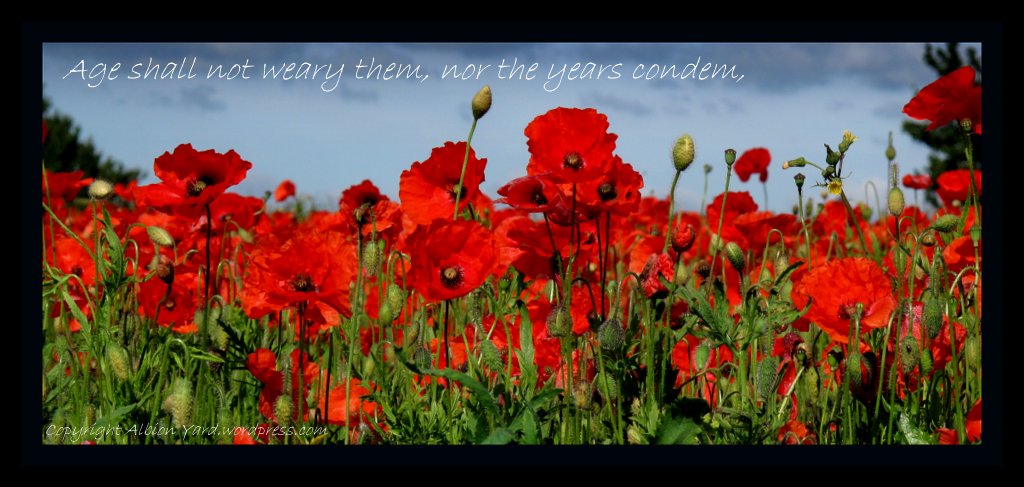
We Will Remember Them

IMG_8486-001

Posted in life, Uncategorized | Tagged , , , , , , | Leave a comment

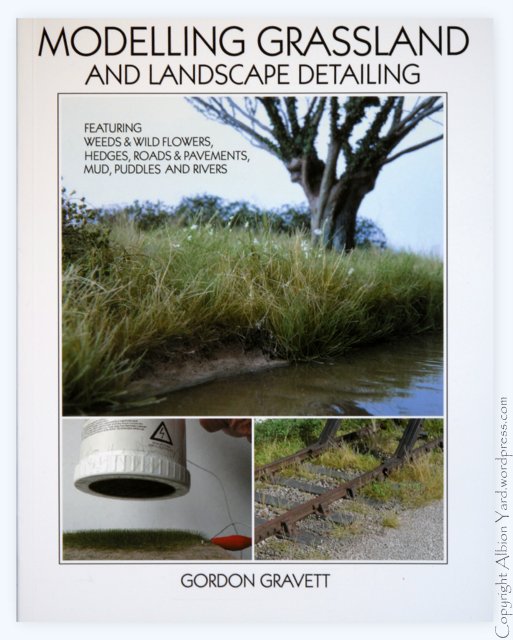
Modelling Grassland and Landscape Detailing (Review)

IMG_1845

Modelling Grassland and Landscape Detailing
Price: 24.95
Published by Wild Swan Publications 2013
ISBN : 978 1 908763 068
Written by Gordon Gravett

This book written by Gordon Gravett, is the third dealing specifically with the techniques he and his wife Maggie use in capturing the landscape in model format. The first two books covered trees, both deciduous and coniferous and this volume looks at grassland and detailing the model landscape. The book is typical Wild Swan format, very well printed, illustrated with quality color images throughout and laid out in an easy to read and follow format. Picture captions are adjacent to images, relevant and concise.

The contents cover the techniques used by the author rather than a discussion of various methods and works well with a logical flow from basic scenery structure construction to the final detailing of plant life The book also covers changes through the seasons and the elements which are key to capture when modeling a specific season. The illustrations are primarily of scales larger than 4mm scale but the techniques shown work well in smaller scales too. The use of the larger scale is helpful for the reader when used to illustrate the layering of static grass for example. The reviewer primarily works in 4mm scale, with this in mind I chose to replicate one of the static grass methods shown using a puffer bottle. I had no prior concerns about the method described, but testing one of the methods is an excellent way of trying the book out as well as just reading it. I’m pleased to report that the technique worked as described and illustrated in the text, and is a new skill learnt!

The majority of the text and illustrations deal with grassland, this emphasis initially seemed a little odd, but the more the book was read the better the understanding was gained on how to get the best from the materials used, and how ‘grassland’ forms the base for much of the UK’s scenery. This is illustrated particularly when making a hedgerow, getting a realistic join between the land and the hedge and its immediate environment. This includes elements such as grass length, weeds and foliage coloring and getting the balance correct. When discussing the ground textures, sections are devoted to modeling road and pavement surfaces . Here there are notes and illustrations of making tarmac and unmetalled roads both urban and rural, which leads into modeling lanes, gateways and puddles effectively.

Water modeling is covered with an emphasis on quieter waterways rather than waterfalls or the sea, the author noting his reservations of the difficulties involved in making effective fast flowing and moving water. The technique illustrated for the river scene used in the book clearly works very well as anyone whom has seen the Gravett’s layout ‘Pempoul’ will know. The chapter on modeling water is one of the shortest in the book, as a reviewer I‘d personally liked to have seen more water examples covered, however this doesn’t detract from that section or the book as a whole.

The book is recommended as a worthwhile addition to a modelers library. The techniques are well described and illustrated with easy to read text, and makes those same techniques accessible for a beginner as well as those with more experience. It’s re-assuring having tried one of the examples myself, that it is easily replicated, and gives good results. That for me is the making of an excellent guide, and encourages the reader to try out or adapt skills and materials to work for themselves.

_B6O4719.CR2

Posted in Airfix, Bachmann, book, British Rail, canada, canon, Eastern Region, Exhibition, Forest of Dean, Great Western, hobbies, Hornby, Ian Futers, Kalmbach, Layout, LMS, LNER, media, Midland Region, Model Railroad, Model Railway, Model Railway Journal, Modelling, Narrow Gauge, Nevard, OO Gauge, review, Scottish Region, Uncategorized, Western Region | Tagged , , , , , , , , , , , , , , , | 2 Comments

Night of the long knives …

IMG_1968

This hobby is one of those where you pick up all sorts of skills, even if its only becoming an expert on packaging and opening the aforementioned items. I don’t know about my regular readers but I often get asked can you do this, or can you do that, because my hobby has a practical element to it, so simple DIY tasks are often pointed my way. Such a day was today, with instructions to bring kids (ours, rather than a random selection), home and get the knives out.

IMG_1970

What do you want to make? I says looking glumly at a large fruit, pumpkins of course aren’t vegetables despite how they may look like one and grow like one, they are like tomatoes a fruit. Well the smallest wallet lightener isn’t really into hammer house of horror, and is into cartoons big time, so a quick look through her favourite books brings out one of Britains finest. ‘Ok then you draw it and I’ll cut it’, or certainly the bits that would lead to an in depth knowledge of the local hospital casualty department when if it all goes horribly wrong. I have to admit it was actually good fun refreshing my knife and carving skills, I’ll likely need them soon. In the next week or two I’m soon going to be doing a similar task on foam board insulation for scenery, and the practise is actually going to be very handy, a pumpkin and foam board having a similar texture. Now you wouldn’t have thought that would you, so if any of you are thinking ‘what will I get out of this I’d rather be opening boxes’, when she offers you a sharp knife, resist the temptation and go and carve a pumpkin instead. The wifes literally walked in and said you’ve got to do the other now, so back to the chopping board rather than the drawing one!

IMG_1973

So about an hour or so later we’ve got our pumpkin in front of an appreciative and attentive audience!

_B6O4719.CR2

Posted in canada, hobbies, Hornby, Kalmbach, life, Model Railroad, Model Railway, Model Railway Journal, Nevard, Uncategorized, usa | Tagged , , , , , , , , , , | 2 Comments

You can’t always get what you want

IMG_1952

Well it’s true, not just in the world of toy trains, but life. One common wail across the interweb and to a degree at shows I’ve been to is the comment I’m waiting for such and such to be made, or painted in that livery. Its not been that long ago that there were cries for the Bachmann suburbans should be re-tooled to contemporary standards. Well that’d be nice I agree, but is it worth it? For Bachmann, commercially, I very much doubt it. These two pics show how my second revised coach has turned out. Its not brilliant, but its a big improvement over the out of the box coach in terms of the windows and underframe detailing. From 60cms or so the inadequacies are largely hidden, and put into a layout environment they are masked further.

IMG_1953
What has it cost? Not a lot, just the underframe etch at a couple of quid and Brians laserglaze windows at £8.00 (Oct 2013). So for the cost of the coaches (used around a tenner) and a further ten pounds in details Ive got a nice coach for £20.00, and I’ve actually made something!

Speaking of making things, it’s not hard if you want to make things, its mind over matter. Of course it’s not as simple as that, but the only thing you can be sure of is if you say ‘I can never do that’, then you’re right. You do have to think differently, along the lines of ‘I’d like to try that’. Then you’ve got past the biggest hurdle, the ‘mind set’. I’ve built a good number of kits and things in the past from various media, and this week I’ve dug out a Craftsman 02 shunter kit. I did this because another building project had stalled, so I put it to one side and got the coach out and this kit.

IMG_1957

There is a logic to the kit I selected, I took something that I knew I’d be able to make progress on, (same with the coach), and that I knew at the end of the session I would have achieved something, that gives me a spur to return to the stalled project. The task I did on the chassis was setting up the gearbox and drive train.

IMG_1958

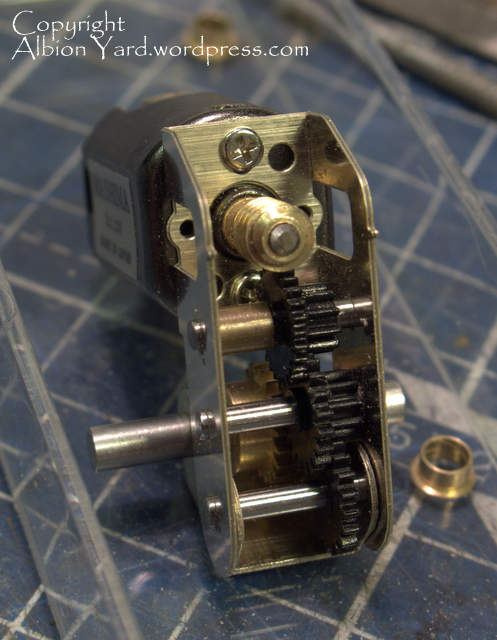
The gearbox is a high level kit, and not for the original kit design. This means that I had to cut and adapt the chassis for the gearbox to fit. Again that’s not a big task, the original Craftsman kit is very simple and the high level kits gearbox is straightforward too. One good thing about Chris Gibbons from High Level is his level of service particularly at shows. He will be able to advise which of his gearboxes will suit. There is also a download which shows gearbox dimensions that you can compare to the kit you’re building. There isn’t a one size fits all option for kits and gearboxes regardless of whose kits and gearboxes your looking at, and some adaptation may be required.

IMG_1963-001

So this is the final fit which now needs fixing and then wheels, connecting rods and then a test run. What working on both these projects did was to give me a ‘win’, which I knew I’d get even before kick off. The point being, rather than getting frustrated with the problem project, the time I spent was profitable, I got what I wanted. In a similar vein Max has been working on some of the ‘traditional’ white metal kits http://probably-the-worst-kit-in-the-world/  and shows another way to deal with these stalling points or stumbling blocks, basically just persevere and make it happen for you, theres value in both approaches.

For me, (and Max), it would have been easier to follow the rest and bleat about not getting anything handed to me on a plate, but at the end of the day I’d still have an empty plate.

Follow the herd?  Nah, that's not for me,

Follow the herd?
Nah, that’s not for me,

With the positive feeling you get from an easy win its way, way, easier to visit the stalled project and make headway with it. That’s what I’ll be doing later, I will get what I want, but I may take a few detours to get it, but I will get it!

In the meantime I’ve got:
A 95% finished coach,
A significant step forward with the 02 kit,
An organic orchard full of sheep, and apples,

_B6O5174

Lots of them.

High Level Kits
http://www.highlevelkits.co.uk/

_B6O4719.CR2

Posted in Airfix, Bachmann, Branch Line, brassmasters, British Rail, canon, DCC, dcc sound, Eastern Region, Exhibition, Great Western, hobbies, Hornby, humour, Ian Futers, Kalmbach, Layout, LMS, LNER, media, Midland Region, Model Railroad, Model Railway, Model Railway Journal, Modelling, Nevard, OO Gauge, Railex, Scottish Region, Southern Region, Uncategorized, Western Region | Tagged , , , , , , , , , , , , , , , , , , | 3 Comments

Mark One Suburbia

img_6127

Revised underframe

Revised underframe

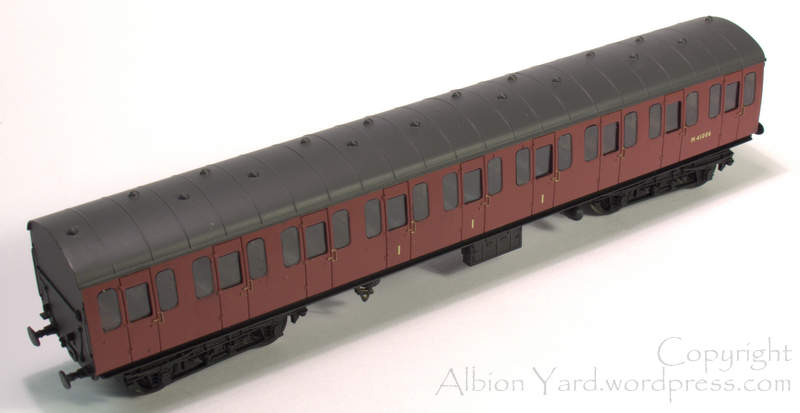
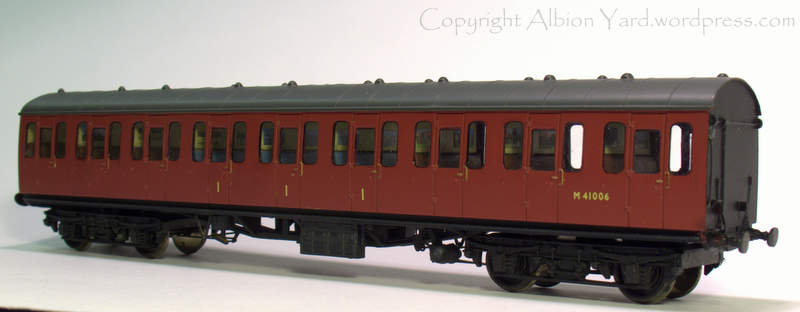
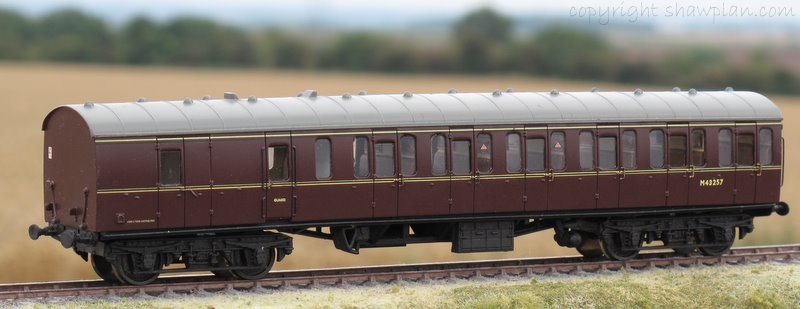
One of the typical coaches for the British Rail era that covered commuter and suburban train stock is the British Rail Mk1 suburban coaches. There are two manufacturers in 4mm scale that produce this as ready to run, Bachmann and Replica. Both of the ranges models are a bit long in the tooth nowadays, and starting to show their age, particularly when compared against some of the newer releases like Hornby’s Gresley and Thompson suburban stock. For one of my projects there’s a good chance that both types of stock would be seen together, so rather than go the etched kit route, I decided to see what I can make of the Bachmann suburbans.

The overall appearance of the coach is good, its shape and proportions are well captured, so its a good starting point. There are two areas that stand out on this coach that would benefit most from a makeover, the chassis, and the windows.  This isn’t a finescale representation I’ve made, it just looks better for a reasonable compromise in time/effort/cost Vs. visual improvement.

The windows are taken care of using Shawplans’ laser cut versions, which are designed specifically for the Bachmann model, see the header picture and how to fit them here http://window-dressing . The seats have been painted and internal pictures added, with no smoking stickers on appropriate windows. The sharp eyed will see the green label on one pair of windows, this indicating a ladies only compartment. The underframe pictures relate to both the brake end and composite coaches as both were assembled as a batch.

This gives an immediate improvement above the solebar, so what can be done to sort its bottom out so to speak. Well, there are three options.

1/ Discard the original chassis and replace it with an etched kit and components from Comet.
2/ Discard the original chassis and replace it with a 57′ chassis robbed from a Bachmann MK1 GUV or BG
3/ Work with the original chassis and upgrade it

IMG_1879

Masokits who’s products are only available mail order, produce the etch used here for detailing the Mark 1 coach. The same etch can be used for the suburban underframe so that’s what I’ve done. Details are here http://www.scalefour.org/masokits/  Item 10.08 The instructions are simple annotated sketches which work well in my opinion for the whole detail kit.

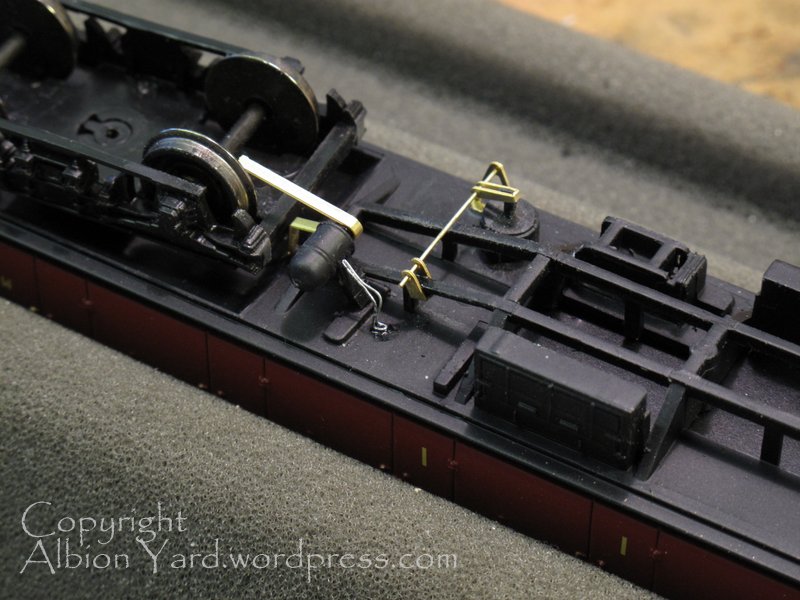
I chose the easy option which is ‘3’. Replacing the chassis with Comet components will give you arguably the best result but at the greatest expense. Using a GUV/BG underframe is also expensive, but isn’t a straight swap, still requiring modification to make a suburban chassis. What you will get with the first two options is the framework of the chassis looking better. I decided that as the coaches won’t be seen at eyelevel for significant amounts of time, I could live with some of the trusses on the suburban underframe being solid, see the header pictures. The brake gear and replacement V hangers I’ve fitted draw attention away from them, and they are partly hidden by the battery boxes too.

Scrap view, Note battery box moved

Scrap view, Note battery box moved

On the brake, one battery box requires moving as they are opposite each other, the composite coach underframes are correct in their layout. All I did was to use a scalpel and score a cut between the battery box and chassis, once the battery had been removed I glued it back on opposite its partner.

The Vacuum cylinders are removed and the V hanger cut off, as well as the actuating arm for the cylinder push rod. The cylinders look a little undernourished, however keeping this simple, I retained them. Comet list white metal cast replacements in their range if you want to change them. Once they’d been cleaned up they were glued back in place and the etched V hanger glued alongside. The design of the V hanger means you don’t need to cut away any of the floor.

Modified Vac. Cylinder, 'V' hanger and Dynamo belt

Modified Vac. Cylinder, ‘V’ hanger and Dynamo belt

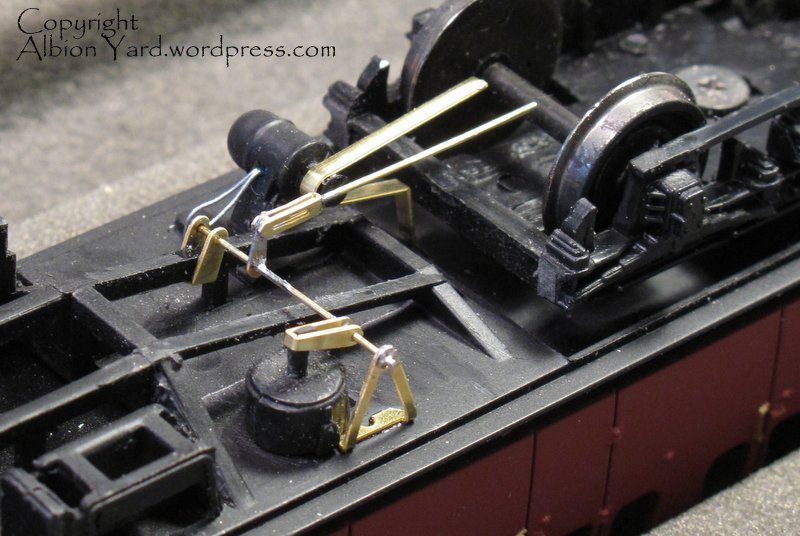
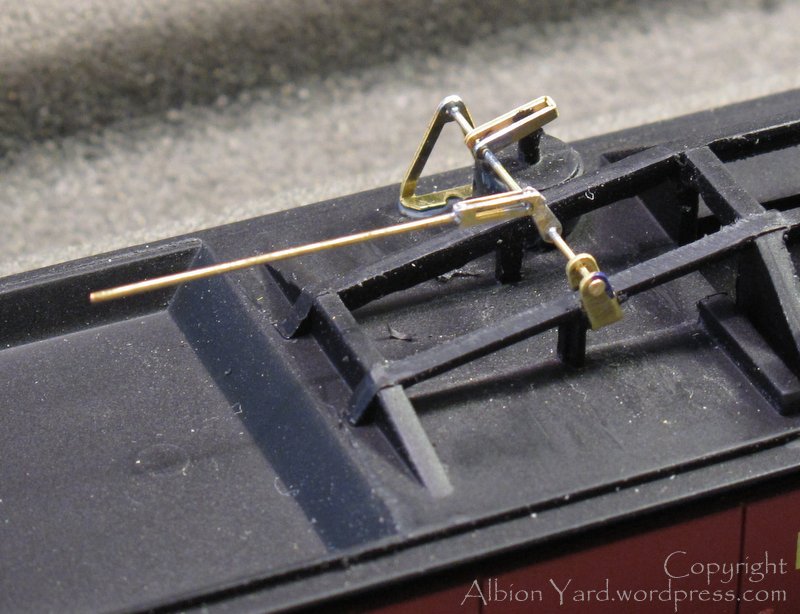
I’ve used dress making pins for the cross brake rods as well as the longitudinal ones. The relevant holes in each etch were drilled for clearance prior to solder assembly. You can use Superglues for this sort of work, however I prefer solder for its strength and adjustability.

Brake Pull rod assemblies

Brake Pull rod assemblies

I make the brake pull rods over length, and then cut them back, to clear the axle, once finally fixed. This allows you to give the impression the pull rods actually go into the bogie structure to perform a function.

Drilling Dynamo for electrical cables

Drilling Dynamo for electrical cables

Dynamo Electrical cable fitted

Dynamo Electrical cable fitted

The dynamo again looks a little on the small side like the vacuum cylinders, but with some careful cleaning they look ok. I’ve fixed electrical cables to them using florists wire, and the etched dynamo belt glues easily around the pulley.

Dynamo End complete

Dynamo End complete

IMG_1891

I’ve got three more of these coaches to do to complete my set, the couplings will be masokits screw type. I’d like ideally to use sprung buffers on these models, but that’s a good bit more work and I’ve other priorities for the layout project these are headed for. If you want to change more of the components for whitemetal versions, contact Geoff at Comet, who’ll be able to help. http://www.cometmodels.co.uk/

_B6O4719.CR2

Posted in Bachmann, Branch Line, British Rail, canon, DCC, dcc sound, Eastern Region, Exhibition, Forest of Dean, hobbies, Hornby, Ian Futers, Layout, Midland Region, Model Railroad, Model Railway, Model Railway Journal, Modelling, Nevard, OO Gauge, Railex, Scottish Region, Southern Region, Uncategorized, Western Region | Tagged , , , , , , , , , , , , , , , | 4 Comments

Rock ‘N’ Roll Star

IMG_1837-001

Perhaps that genuine buzz looking at the who’s who of names from the history of our UK branch of the hobby engraved in the Visitors Cup, is a touch of what it feels like to be a rock and roll star! The layout won the Manchester Model Railway Societies Visitors Cup which was a real surprise, and thank you to all those whom voted for the layout. My toy train history follows on from my late father, and the MMRS show has always had a very high reputation for quality, deservedly so in my opinion. Receiving the cup was one of those occasions where you just wished Dad was still around.

We were privileged to have some very special visitors at the show

The Twins

The Twins

The Twins

The Twins

Two new releases ...

Two new releases …

IMG_1812

I can report they ran beautifully, almost silently gliding across the trackwork, seeing them close up has sold one twin set at least! The real stars of the show though are the visitors who come through the door, we were frequently asked about many aspects of the layout, DC vs DCC & sound (we ran both, DC Sat/DCC Sun), the trees, the backscene and the display ‘concept’ including the height, seamless backscene and hidden fiddleyard. It was very pleasing to meet and answer the questions so thank you for taking the time and interest in the train set, it really does mean a lot!

IMG_1809-001

IMG_1811-001

_B6O4719.CR2

Posted in Airfix, Bachmann, Branch Line, British Rail, canon, Chris Nevard, DCC, dcc sound, Eastern Region, Exhibition, Great Western, hobbies, Hornby, humour, Ian Futers, Kalmbach, Layout, LMS, LNER, Manchester, Midland Region, Model Railroad, Model Railway, Model Railway Journal, Modelling, Nevard, OO Gauge, Photography, Railex, Scottish Region, Southern Region, Uncategorized, Wales, Welsh Marches, Western Region | Tagged , , , , , , , , , , , , , , , , , | 8 Comments

Manchester, Wonderwall, Eeee, Cup of tea anyone? ….

IMG_1760

This weekend its the Manchester show, and Albion Yards penultimate showing. Its been a couple of weeks since Model Rail Live at Newark where Albion Yards own ‘wonderwall’ the seamless backscene, was one of the features of the layout that generated a lot of interest. More on the backscene in a future posting. I’ll be packing my northerner/cockney handy phrase book too, so I can translate such phrases as ‘Eeee lad, that’s grand, that is’ etc.

Manchester has a well deserved reputation as one of the really good shows on the circuit, and Easington Lane, http://www.easington  an EM layout is also having its last showing before passing to new owners. The Em gauge 70’s http://www.emgauge70s site included  on the links, is well worth sitting down with a cup of tea and having a rummage through. Even if you’re not into D&E modelling there’s plenty there to be inspired by.

Come and see us at Manchester and say hello, there’s a new addition to the roster of a Dapol 22 in green. I’ve only done a little to it so far, but I think there’s quite a good little type 2 hiding behind some ‘interesting’ design features.

http://www.mmrs.co.uk/exhibition/exhibition.htm

_B6O4719.CR2

Posted in Airfix, Bachmann, Branch Line, British Rail, canon, Canon G10, DCC, dcc sound, Eastern Region, Exhibition, Forest of Dean, Great Western, hobbies, Hornby, Ian Futers, Industrial, Kalmbach, Layout, Manchester, media, Midland Region, Model Railroad, Model Railway, Model Railway Journal, Modelling, Nevard, OO Gauge, Scottish Region, Southern Region, Uncategorized, Wales, Western Region | Tagged , , , , , , , , , , , , , , , , , | Leave a comment