Cavalex Trains4U KFA PFB Flat Wagon Review

Trains4U / Cavalex Warflat

This year has been a bit of a quiet one for the blog, two layouts ticking over and a busy domestic and work schedule, hence relatively few updates. However earlier in the year I had the pleasure of speaking to Gareth Helliwell from Trains4U in Peterborough. The shop was opened in 2004 as a response to the last ‘traditional’ type of model shop in the immediate Peterborough area closing. Some eighteen years later Trains4U is still going and supplies railway, slot car and plastic kit hobbyists in the Peterborough area with a well stocked walk in retail unit, and an efficient and competitively priced mail order service. Whilst talking about the hobby in general, and him selling me a Dapol N gauge 33, (how does that happen?), Gareth showed me the first tooling shots of the Cavalex Merry Go Round wagons which look really nice. He also asked if I’d like to look at a couple of their T4U/Cavalex warflats for a review on the blog, the connection being that Cavalex were the production partner for the project. I thought they’d make an interesting change, with these wagons being outside my normal sphere of interest and era, but I am finding that my rail interests are quite flexible in timelines and have moved towards more recent times of late.
Trans4U / Cavalex PFB KFA Warflat

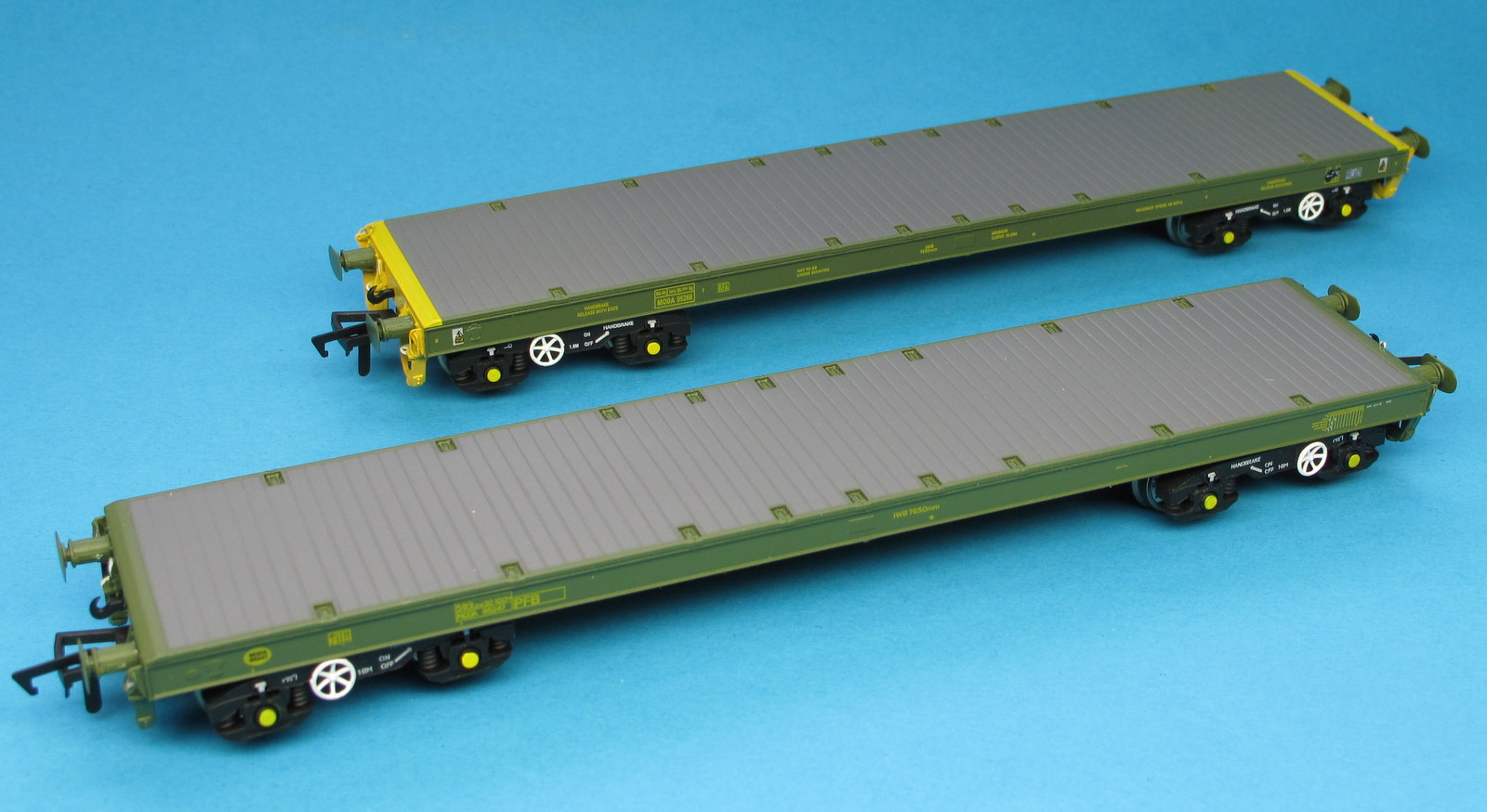
The two wagons here are known as warflats and their primary design requirement was to be able to transport military vehicles such as armoured cars and other lightweight vehicles. The choice for the prototype was from the T4U team, wanting to add an unusual but useful and widely utilised wagon into the range of modern RTR rolling stock. The wagons were introduced in the mid 1970’s under the TOPS classification PFB, and were dual braked, featuring both vacuum and air brake systems. The wagons are still in MOD use today but are now solely air braked with the TOPS code of KFA. The model is available in two liveries as the earlier PFB ,and later KFA versions. Each wagon type has three different running numbers to choose from, and the two liveries cross over, so you can run all six in the same train prototypically.
PFB KFA Warflat

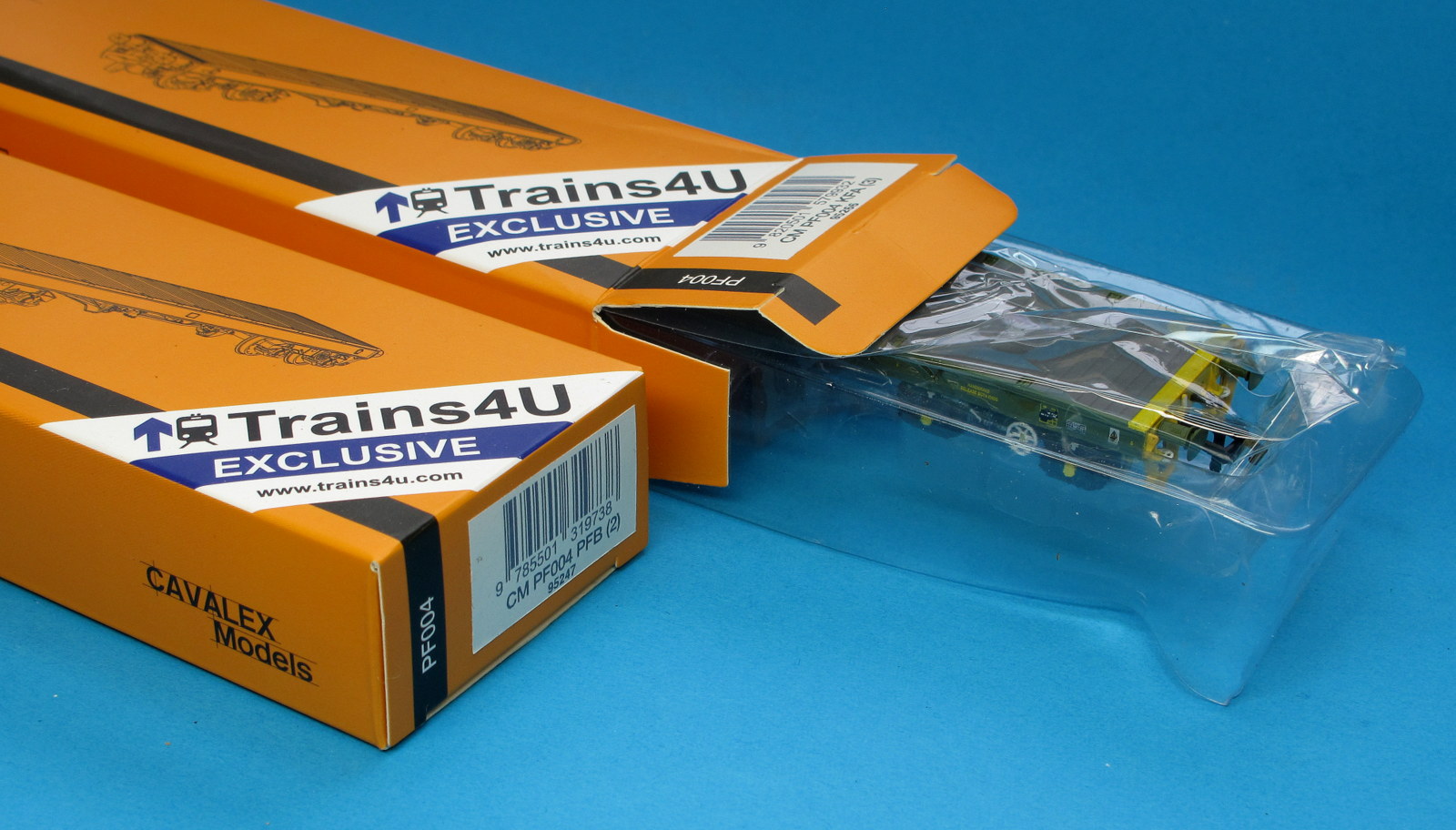
The packaging for them is simple and robust. A stiff outer carton and moulded ‘ice cube’ inner tray with close fitting lid holds the wagons securely including the detail pack of air hoses. all appear to be recyclable. With the first look at the wagons they are well assembled with no loose parts the paint and livery The wagons weigh in at 91grams each, the deck being a plastic moulding and the spinal frame underneath of metal. Looking at the running gear, wheels and axles are metal on 26mm standard axles housed in plastic bogies.
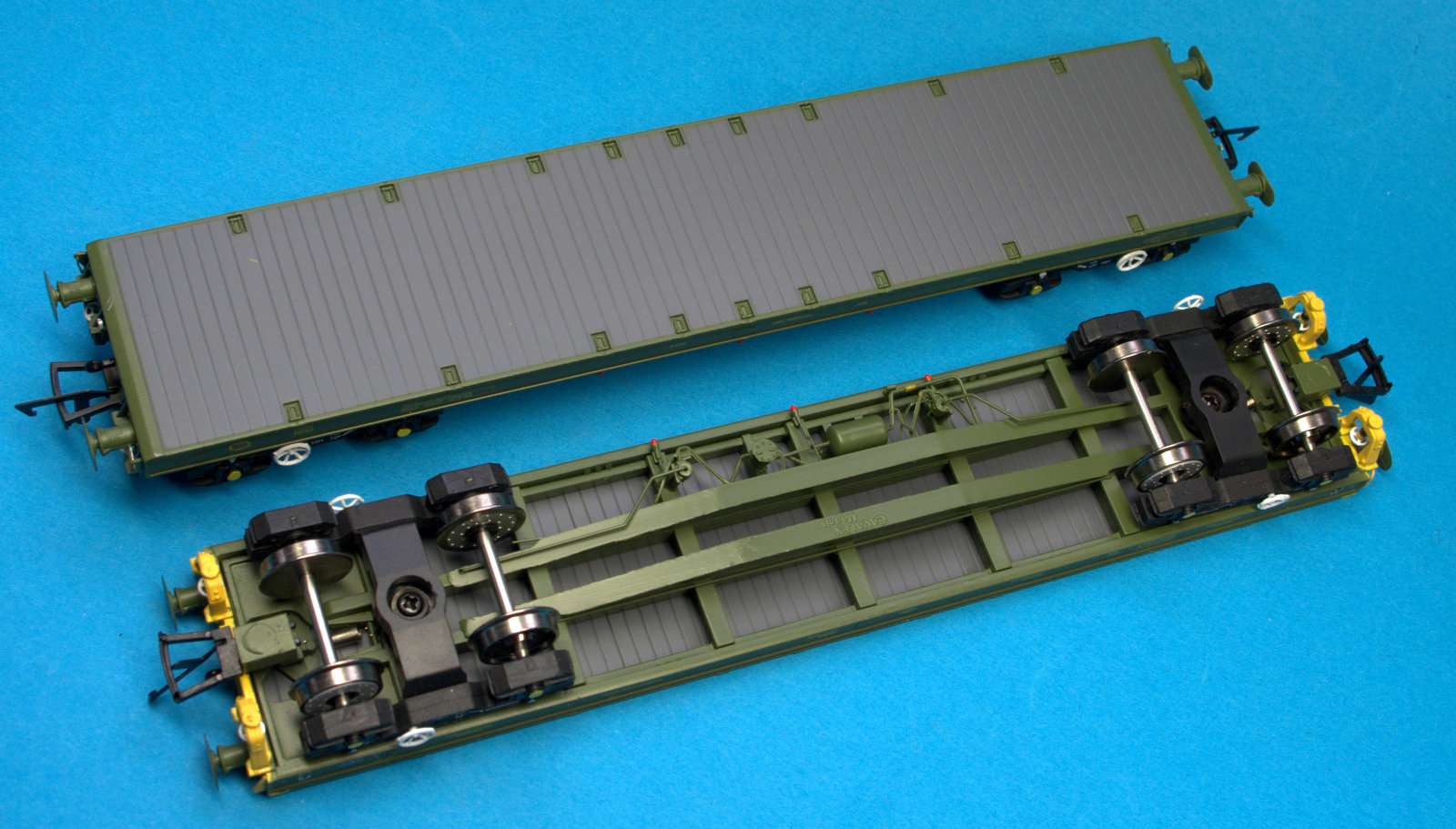
Trains4U Warflat

Realistically this is more of an overview than a review, not being familiar with the prototype. Both the wagons are identical in build so its a livery variation that makes the difference. in terms of the detail differences between the liveries there are none and the build and moulding quality is identical over the two models. so in terms of the physical appearance of the wagons these words apply to both liveries.

KFA Warflat

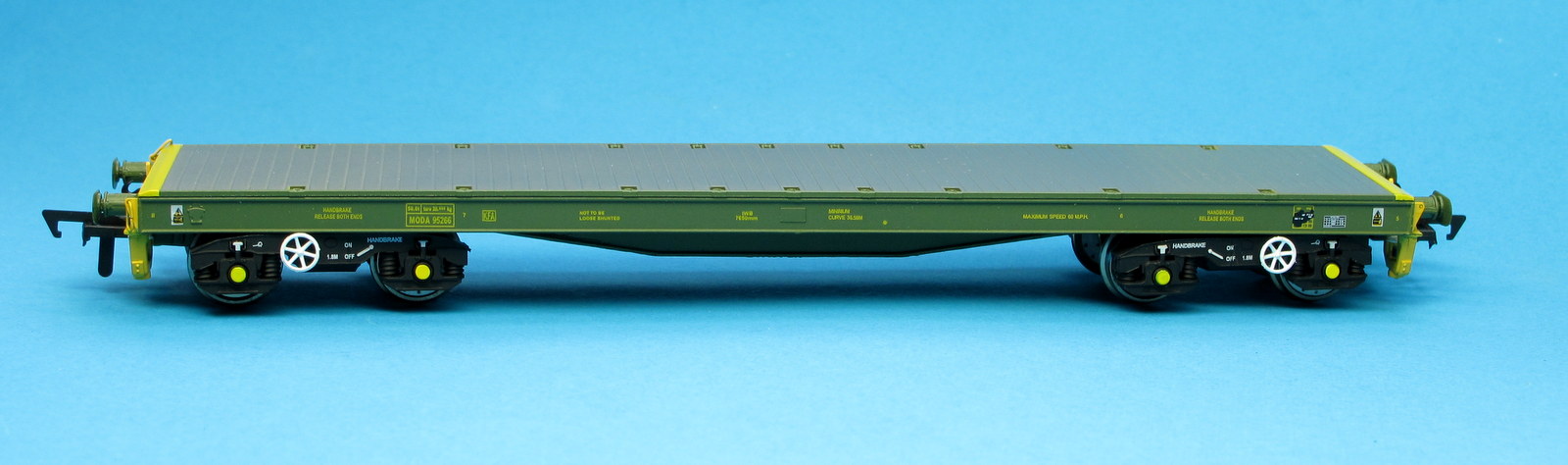
The KFA then is the model I’ll start with, this is in the later livery with the yellow end stocks. The whole body moulding is very cleanly moulded with no apparent tooling slide lines anywhere. Top deck planks are well defined with cutaways for fixing shackles or tie down straps to wagon tie down locations. The end of each wagon has a subtle grip pattern on the tops of the buffer beams. All edges are sharp and on the side beams the wagon label clip for paperwork is well defined.
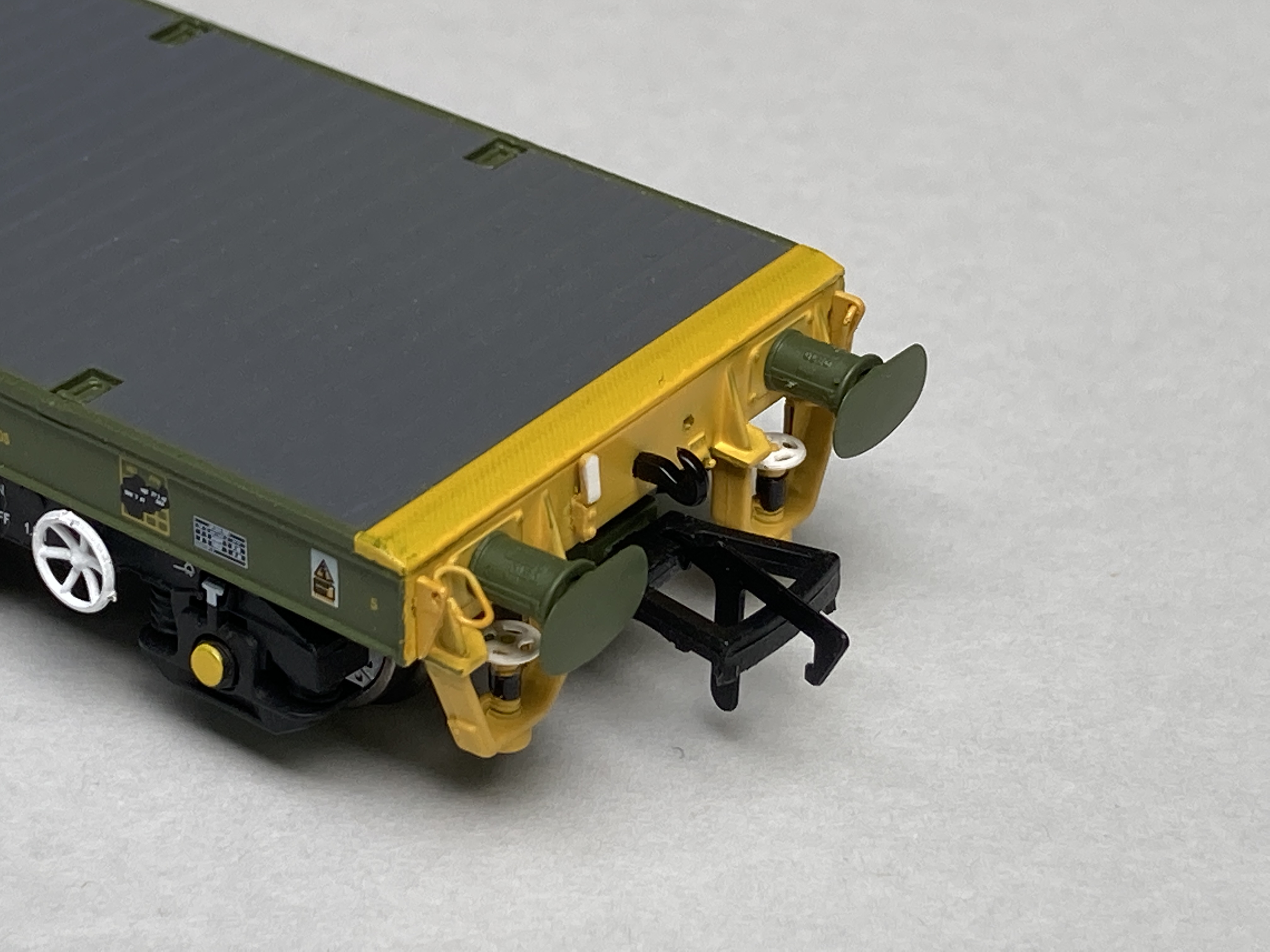
KFA Warflat

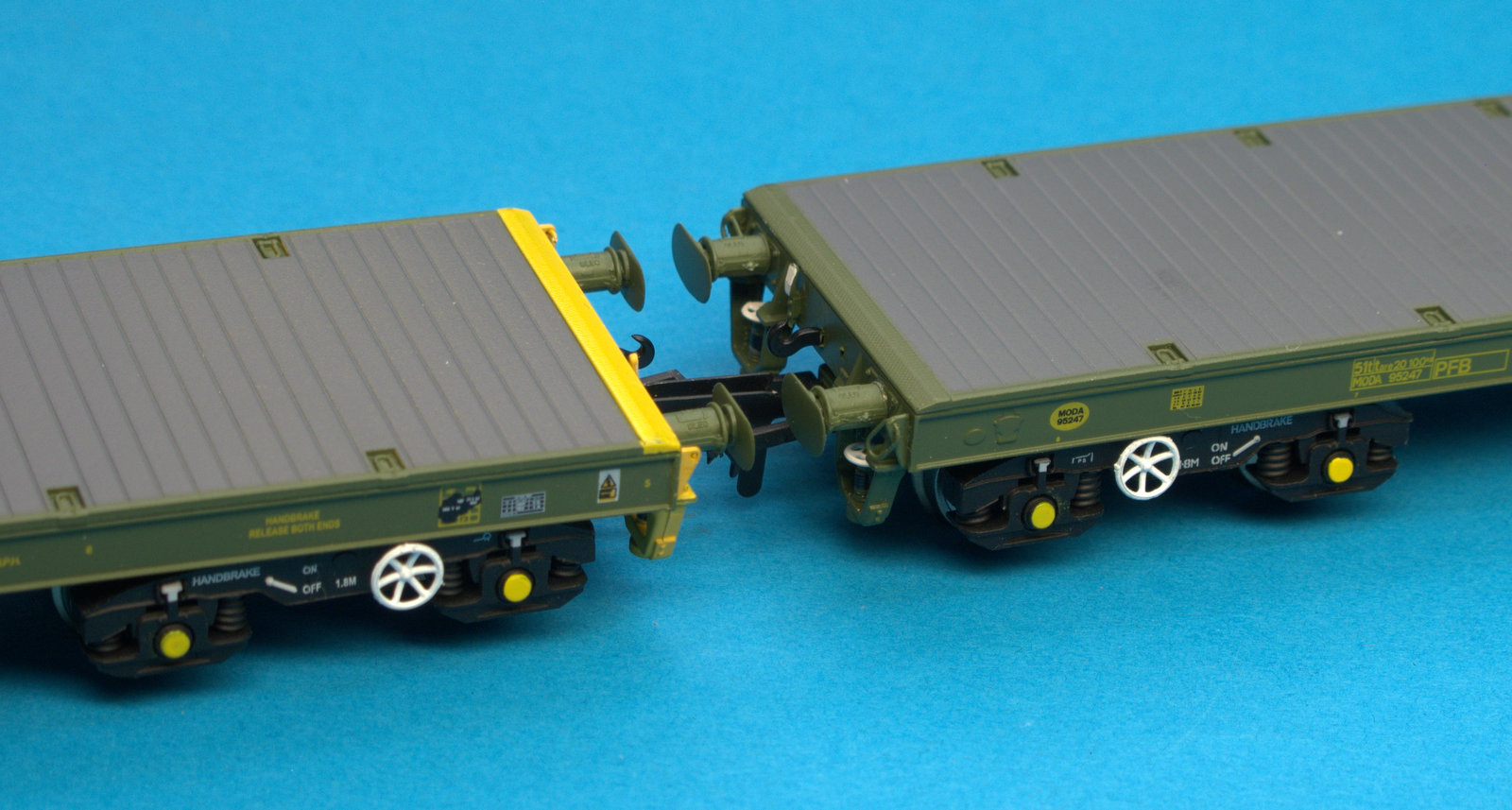
The buffer beams are a notable area of detail, the buffers are sprung, with oval heads. These types of buffer are often left with the ability to rotate on RTR products, but these are kept horizontal and have a commendably thin head to them. Outer edges of the beams have individual loops for tie down and chain fixings which I was very impressed with. Screw jacks are fitted to the underneath of the buffer beam and are fitted with the appropriate hand wheel and modelled in the raised position. They are correctly situated so they’d align with scale gauge track rather than OO but the difference isn’t particularly notable. These do show a mould line on the side of them but you do have to be very close to notice it.
T4U Cavalex Warflat

Standard tension lock couplings are fixed to a kinematic housing on the underside of the wagon. Despite the screw jacks being in position there is no fouling of the couplings under test. The minimum radius I tried was Peco medium radius points both under tension and propelling.
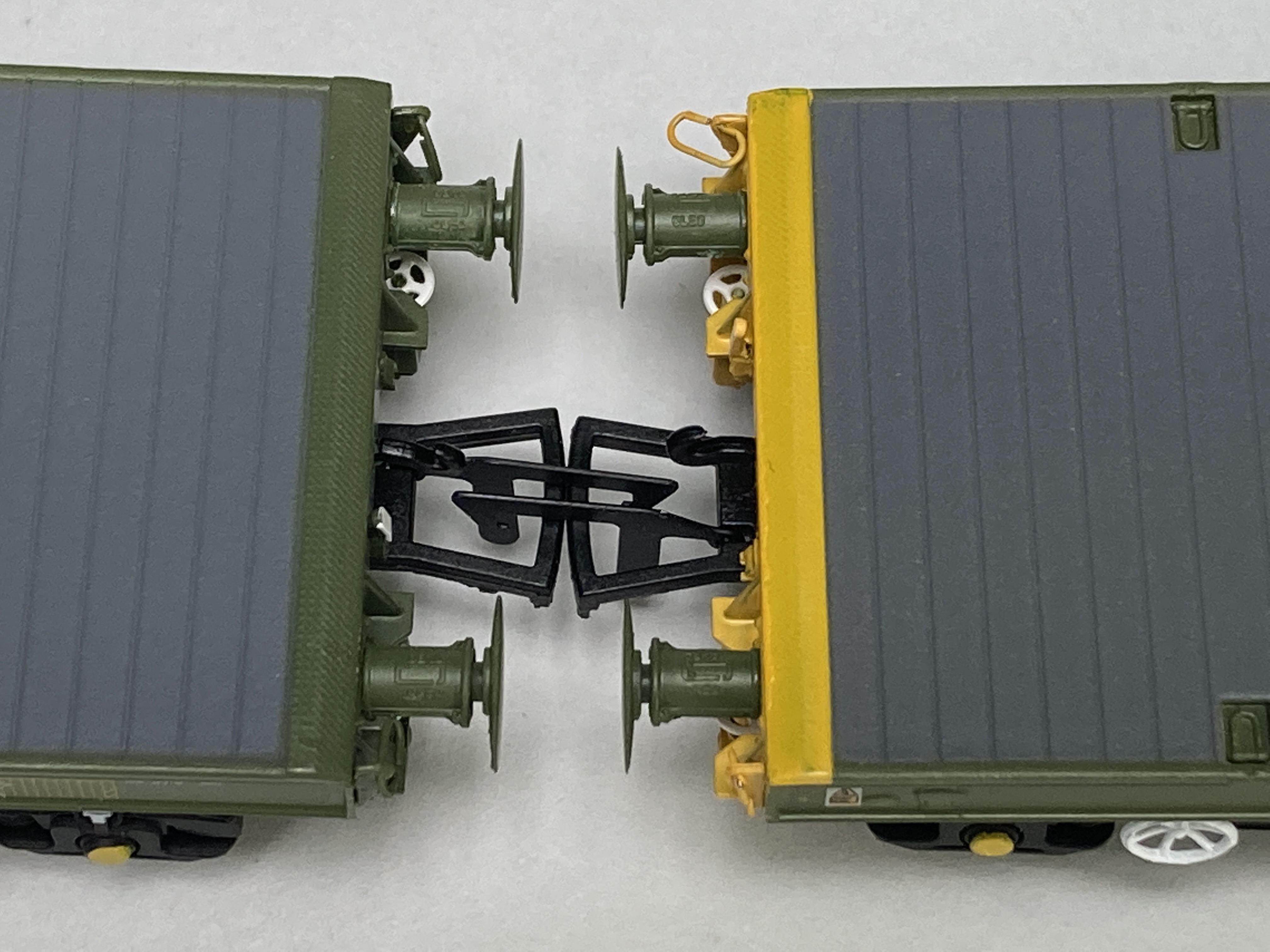
KFA PFB OO Warflat

One thing of note was the side play of the tension lock hooks in the actual coupling, I felt this was a little too loose however I didn’t experience any problems myself but if used on set track its something to keep an eye on. The livery of the buffer beams is the major noticeable difference between the two models. On my sample the yellow wasn’t quite as opaque as I’d have preferred, however with weathering applied that won’t be an issue, and I’d rather it be that way than have the paint too thick and obscuring detail. Individual lamp irons are applied and there’s one hole for the air pipes supplied as additional details. If representing an earlier wagon with dual brake pipework, it will be up to the purchaser to source and fit the additional pipes for the buffer beams. The wagons were ‘through’ piped for vacuum work and would have run with a brake van attached to provide braking power.
PFB KFA Warflat

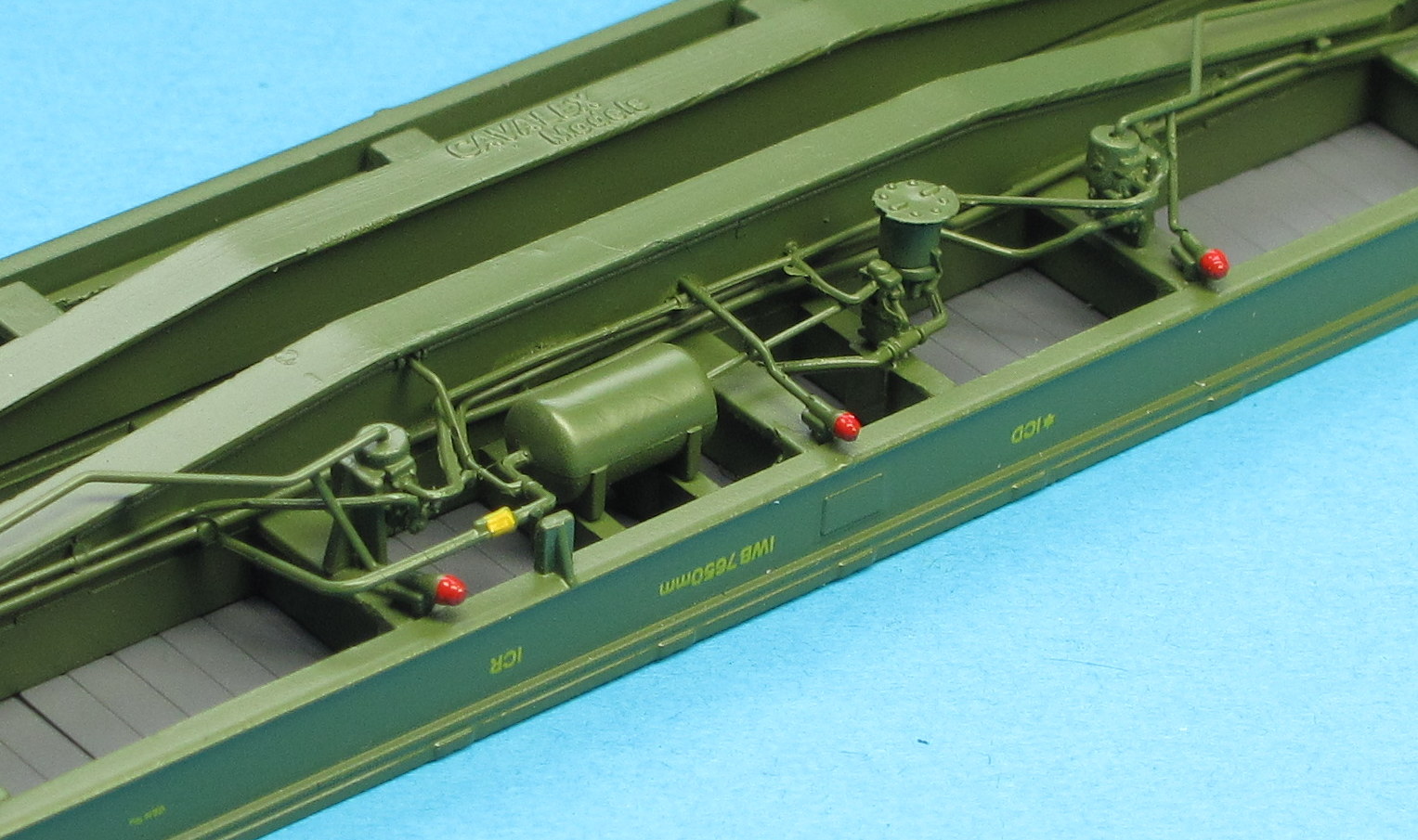
The under frame of the wagon is very well detailed with fine pipework and mechanism details. The details represent the air brake only type, I’ve not been able to find any accessible detail information to determine how the vacuum pipe was routed for the dual brake version. They don’t appear to be visible on any of the online resources, so unless you’re regularly turning your wagons upside down, not a huge omission to get foaming about.

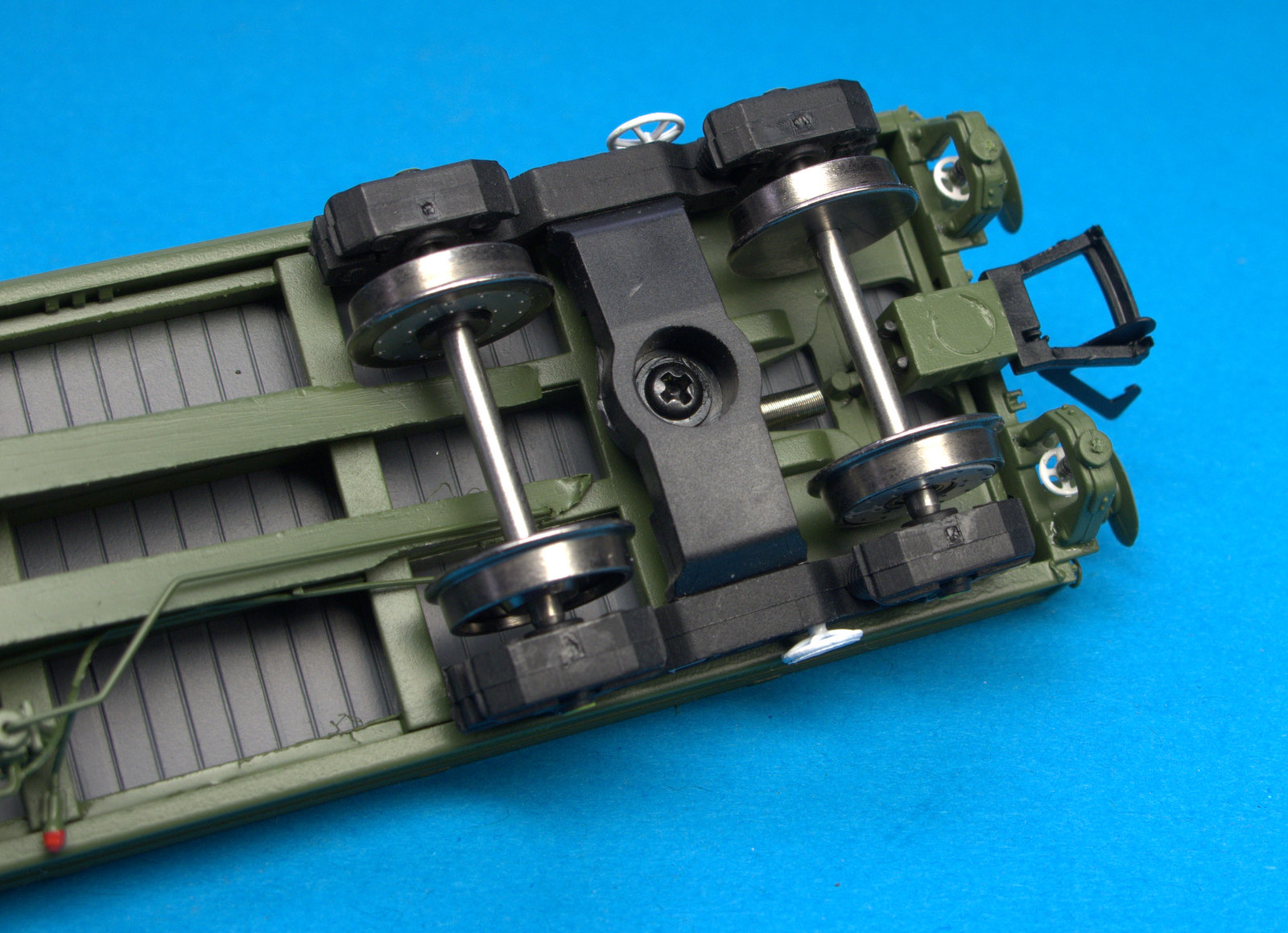
The NEM coupling mounts are fitted to a kinematic system fixed at the ends of the wagon floors. If using three links the housing looks like it can be removed, but as these were samples, the screwdrivers stayed in their box! The chassis as mention above is a metal casting giving an overall weight of around 9 grams, or about the same as a typical sized iPhone for ease of comparison.
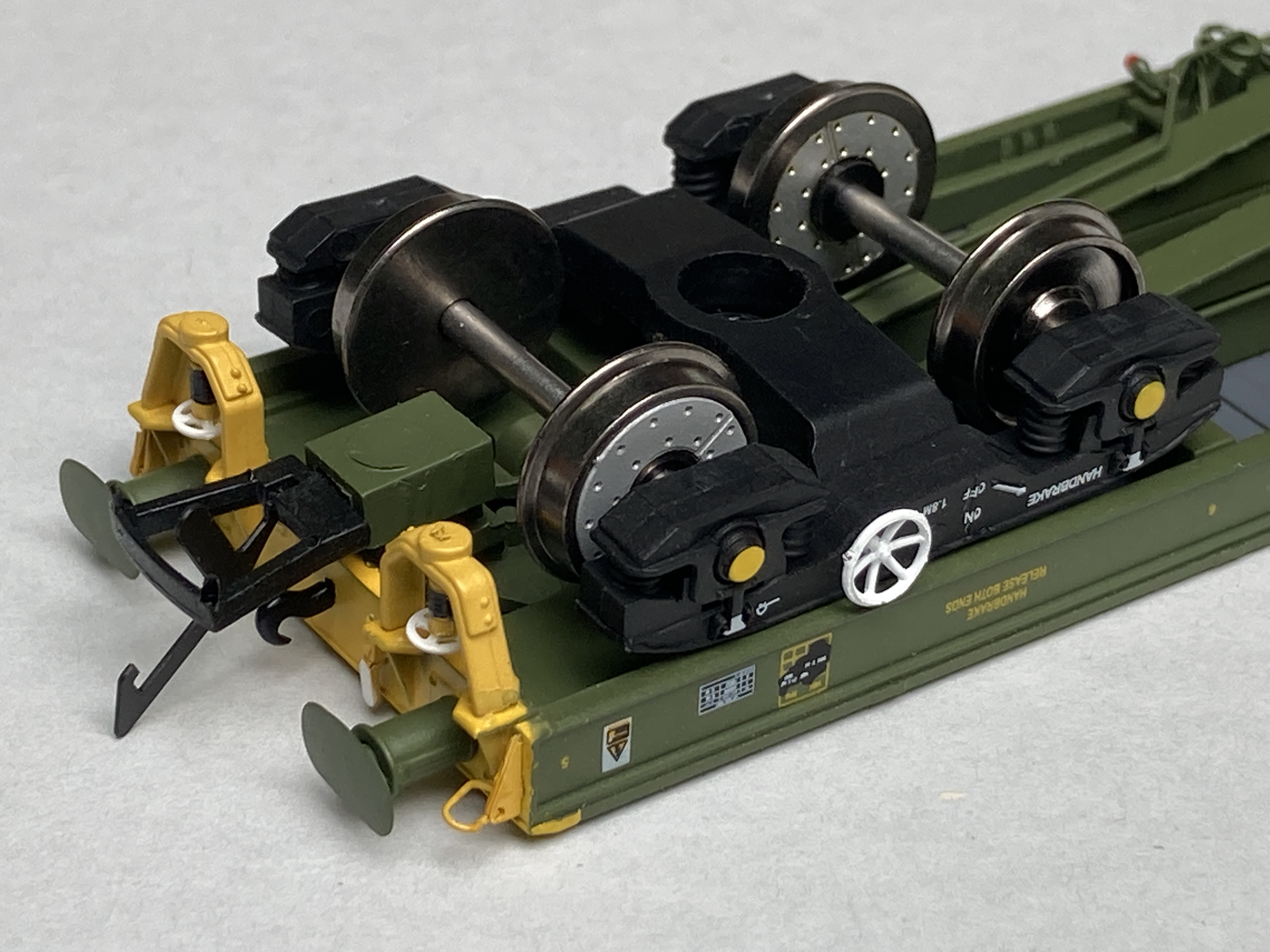
KFA PFB Bogie

The bogies are plastic with a crosshead screw fixing to the chassis. The bogie side frames are one area where I feel the model is let down slightly. The side frames around the axle box is particularly thick, which does occasionally show when the wagons are viewed end on or on a sharp radius curve. I should mention that’s possibly more noticeable for me due to the height my layouts are set at, however in comparison with the Cavalex TEA tanker there’s a notable difference in comparative thickness. Individual brake wheels are fitted to the side of each bogie and the unusual diagonal brake disc configuration is captured using plastic inserts into the individual wheel sets. Running qualities of the wagons are excellent, both wagons running without any binding or wobble from poorly adjusted or fitted wheels. There doesn’t appear to be any hinderance for people wishing to put either EM or P4 wheel sets in the bogies there looks to be more than adequate lateral clearances, with no brake gear to foul.
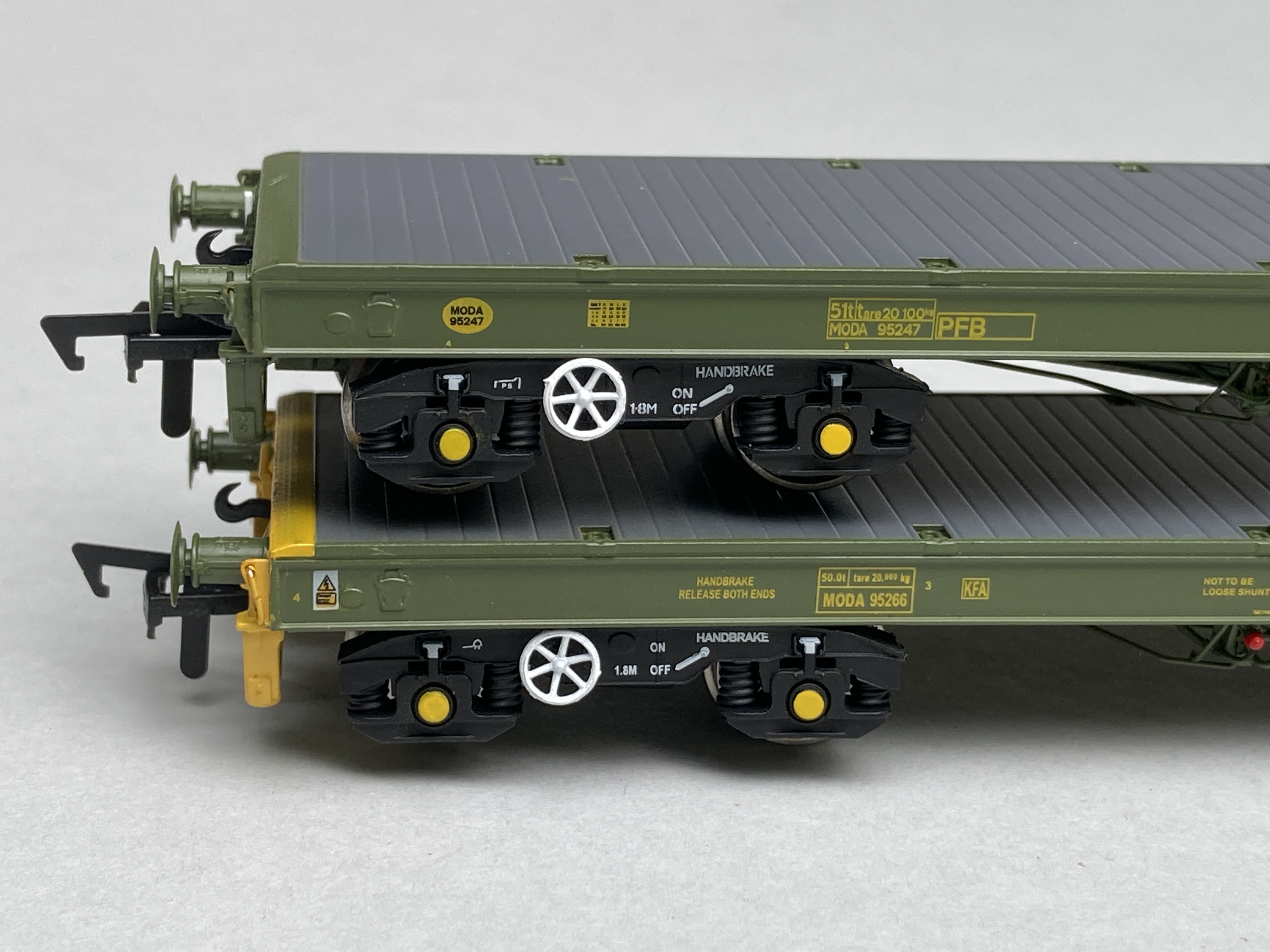
Livery application is excellent for both wagons. Apart from the minor yellow opacity issue on the KFA, all paint is applied neatly with no ‘overspray’ or bleed marks.
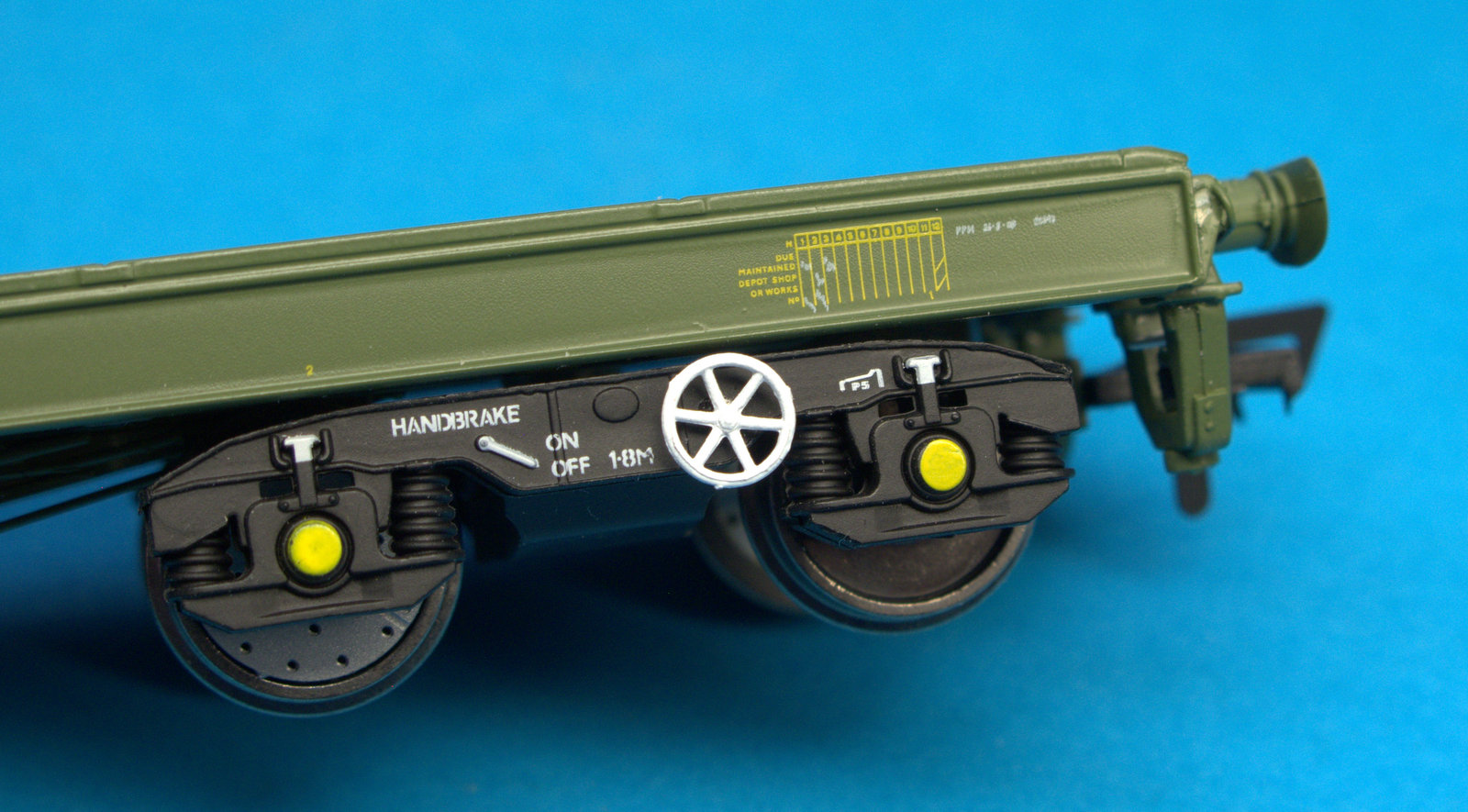
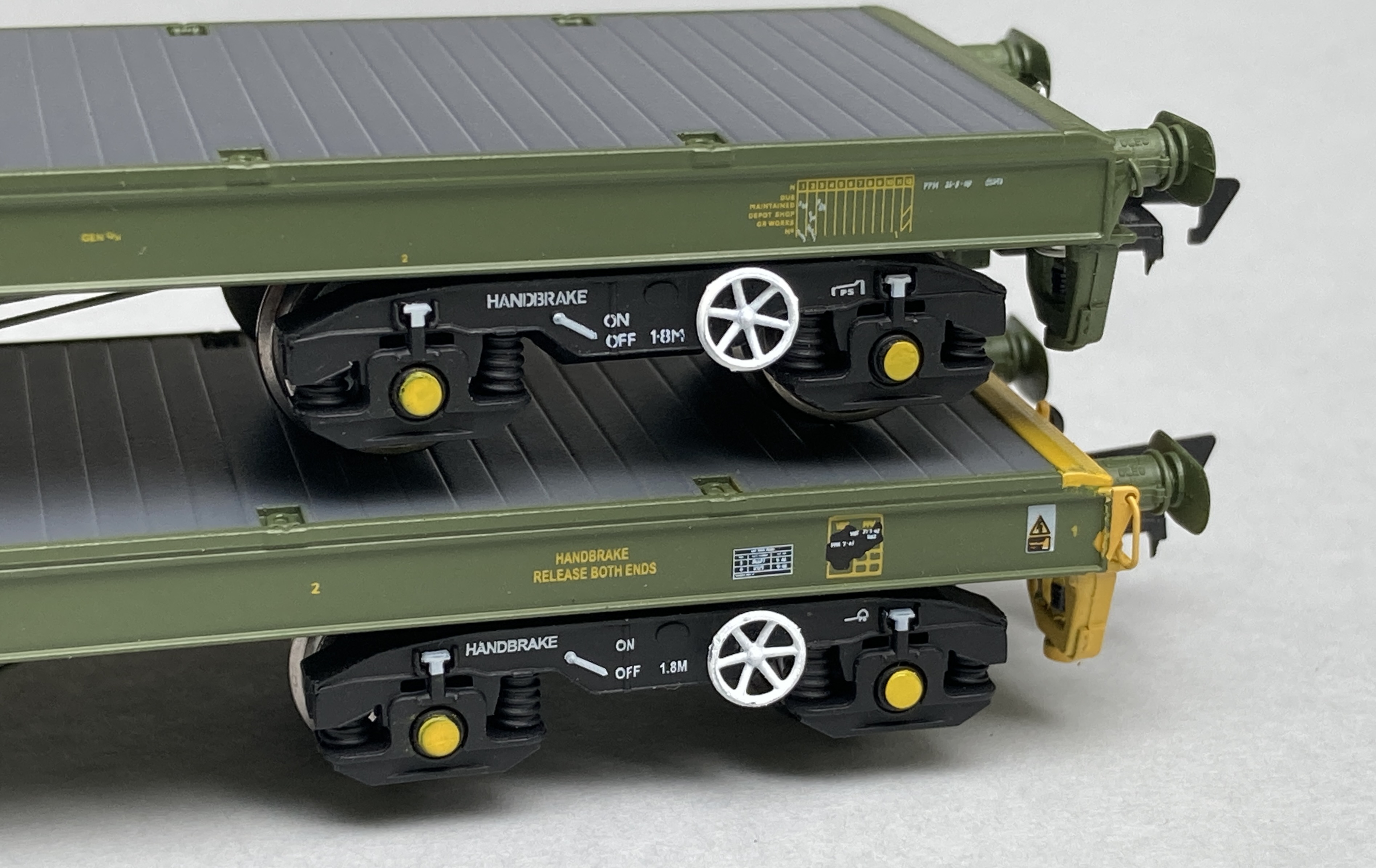
The printing of the data panels is excellent across both versions with all but the smallest writing clearly legible, and matching locations from on-line pictorial references. If you wish to model the wagons loaded there are 3D printed vehicle chocks available too designed specifically for these wagons.
In summary then these are very good models of an interesting and long lived prototype. Its the first opportunity I’ve had to look at a product from the Cavalex team, and overall its a very impressive model, well built, well detailed and decorated. Used widely across the UK for moving light weight military vehicles, they can be used in full length military trains or one or two of these wagons and other suitable stock such as VEA or VGA type vans. The longevity of them from the mid 70’s to the current day, and only two significant liveries gives modellers a good excuse to add something a little different to the fleet without spreading the boundaries of plausibility!

http://www.trains4u.com/

Posted in new release, review, Uncategorized | Tagged , , , , , | Leave a comment

Throwback Thursday Hornby TT120 October 22

A week back 10/10/22, Hornby announced they were in the new TT 1:120th scale market.

Earlier in the year Peco introduced a range of products both track and buildings, a few of which are sitting on the review shelf here.

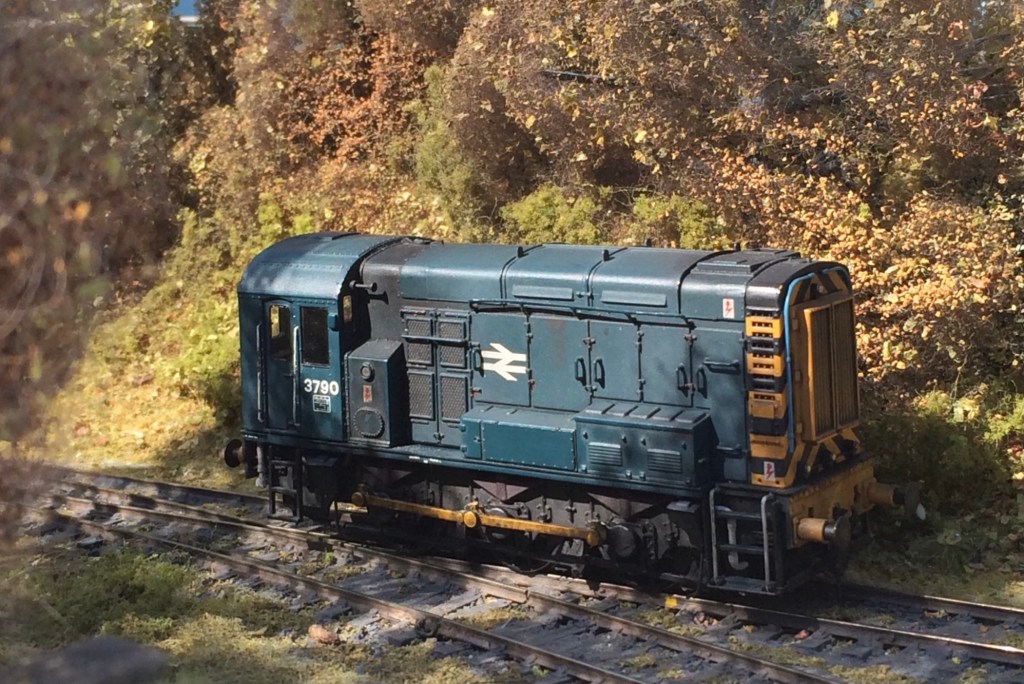
Heljan also threw their hat into the ring with the fascinating prospect of a high fidelity class 31, and the potential of an 08 and J94. With the Hornby announcement both 08 and J94 were listed as products in development and Heljan have subsequently taken the decision to withdraw from the TT market due to the potential of duplication and the obvious negative impact that could have on sales. Of interest was Rails of Sheffield, also copying the same withdrawal announcement onto their Facebook page. I do wonder as Rails have commissioned their own products and limited edition liveries, if perhaps they were considering entering the market and hadn’t yet shown their hand. Needless to say all the above have nearly filled the internet with froth and wibble, so I’m very fortunate in having a little area of clear space here! Its understandable that Heljan, Rails and perhaps others are not considering entering this new scale, the cost of developing a new model across the scales isn’t far apart, so entering a new scale with duplications in ranges, could hamper the development of all ranges, Hornby’s included.

Also different is the marketing approach from Hornby, with them going direct, rather than sales via a dealer, high street presence.This is interesting on two fronts, it has the potential of restricting the market in that other manufacturers and retailers may decide that if there isn’t a critical mass in the market place with TT being widely available ‘on the high street’, there’s little point in developing accompanying ranges.

Peco TT

Peco have taken a very astute way forward in using wooden laser cut kit technology here, thus reducing the financial burden which injection moulding tooling would add to the new scale. They have also invested in tooling for the track ranges, and in the event of the scale not gaining commercial traction in the UK market, that track range sits well in their portfolio, and would sell into the existing European market at the very least.

Warley in a few weeks time is going to be an interesting show in terms of trade announcements. As the headline act in the exhibition circuit its a good place and time to grab a headline. Its possible that some of the other smaller agile manufacturers and commissioners may show their hand in developing new products. Accurascale have already commented via social media that they aren’t contemplating the new scale, and others like Rapido, Cavalex, RevolutioN Bachmann to name just four off the top of my head haven’t yet passed official comment that I’m aware of.

As far as Hornby’s direct sales approach goes its not hard to see the value of it to Hornby, it sort of makes it a captive market. That can have a benefit in that it could drive the majority of TT sales into the Hornby bank account, so good for the shareholders, and Hornby’s bottom line. Obviously retailers would be excluded if we understand the business model announced so far. There’s been plenty of wibble saying this approach won’t work, but the general public won’t have an appreciation of the subtleties of the tie in to the retail trade for other components. I’m very conscious of the way the Low Cost Airlines tore up the travel market twenty years ago. At the time there was plenty comments that people wouldn’t book direct etc etc, but very quickly the public did adopt these new business models and decimated the travel agent industry on the high street, and internet development has radically change business and communication practices, part of the reason I can write this here and you read it!

Hornby have clearly spent a large sum of capital in the development of this range, and we can expect a large amount of advertising to give the range traction both inside the hobby, and to appeal to the public to visit the Hornby website to purchase the products. Over the past few years, even prior to the current economic and political turmoil the world is in, supply chain issues and delays in manufacture have affected all the key players. In the presentation this is addressed with the assurance that there will be a regular flow of product to be available. This supply chain is vital, particularly track. Whilst Peco have introduced flexitrack and the large radius points they’re not the elements that will be required by the public when entering this hobby. I do wonder with Heljan stepping back with an intriguing TTFN sign off, if the industry will wait to see how well the new sale takes off? The online only aspect cuts down the visibility of the scale, particularly on the high street, and if you include ‘box shifters’ web presence and magazine advertising, potentially cutting out those high profile attention grabbers too. The 3D printers such as Modelu may well see an easy niche market to trade in, but its possible that the larger players will step back and see if Hornby is ‘right’, before cutting tooling of their own to currently ‘support’ Hornby’s new marketing drive and product range. There’s little point in range duplication at this point of the development due to the costs involved and limited idea of the scales acceptance by either the public or the established hobby.

Do I think this a good move in the hobby? Overall yes I do. I’ve often thought that TT would offer meant others like me the balance between capturing scenery, and being able to model ‘more railway’ more effectively than either N or OO/HO can provide in the space available. In response to this I have pre ordered an 08 in BR blue as a trial, to see the effectiveness of the new scale. I also have some of the Peco products to build and try out too. The Hornby presentation makes note of the scale and space available conundrum, and the pricing of the models looks reasonable compared to other RTR products, and I think the points are well presented. If the scale works commercially I could see it becoming my primary modelling scale, particularly for the Forest of Dean project I have in mind.

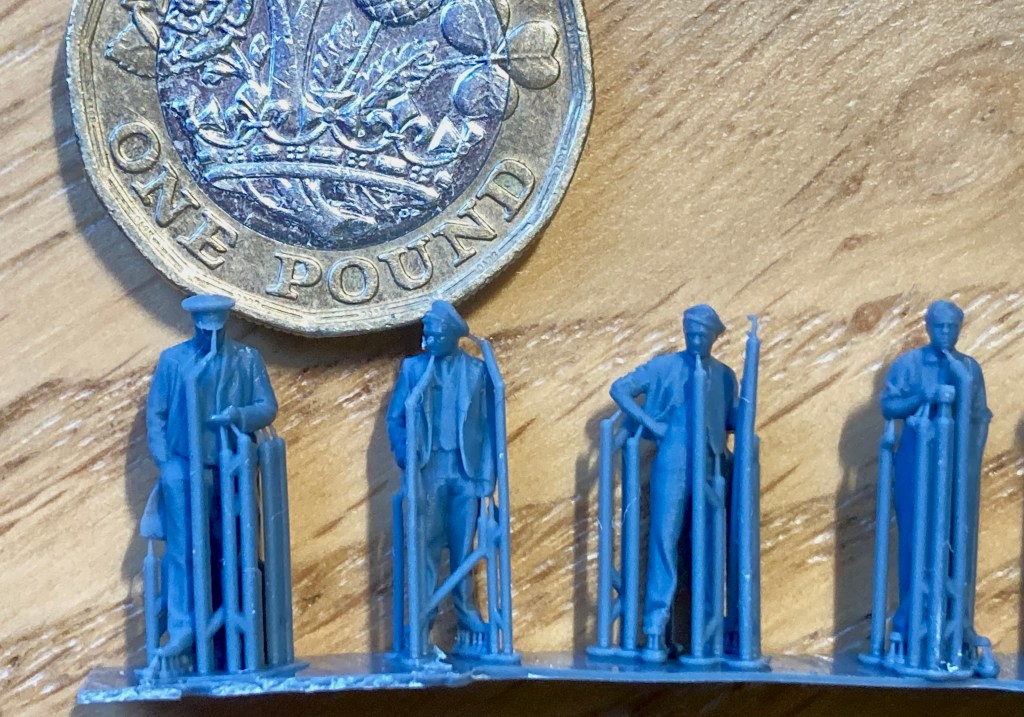
Modelu 1:120 TT figures

The big question though is have Hornby judged the market right? Do they have a robust supply chain and flow of new and ‘existing’ product to support a new scale? I hope they do, its a good news story that the hobby is seen as being able to accommodate a new scale, and a major player is putting a huge amount of money and effort into this new direction. If it takes off it’ll be an excellent boost to the hobby and for Hornby. If it doesn’t go well, it has the potential of significant damage to the Hornby business, and potentially to the overall hobby in the retail sector. Hornby have rolled the dice, lets see what numbers come up!

Posted in 3d, 3d printing, accurascale, Bachmann, blog, British Rail, Cameo, Cameo layout, DC, DCC, dcc sound, Exhibition, finescale, flying scotsman, Forest of Dean, Great Western, Hattons, heljan, HO, ho scale, Hobby, Hornby, Inspiration, internet shopping, Layout, man cave, media, model, model photography, Model Railroad, Model Railway, Modelling, Modelu, n gauge, Narrow Gauge, news, O Gauge, o scale, OO, OO Gauge, peco, Peco TT, product news, railroad, Rails of Sheffield, railway, Rapido Trains, scale, scale modelling, shelfie, throwback thursday, thursday throwback, toy train, train set, TT, TT Gauge, Uncategorized, warley, woodland scenics | Leave a comment

Motivation Monday, Iain Rice, Influencer

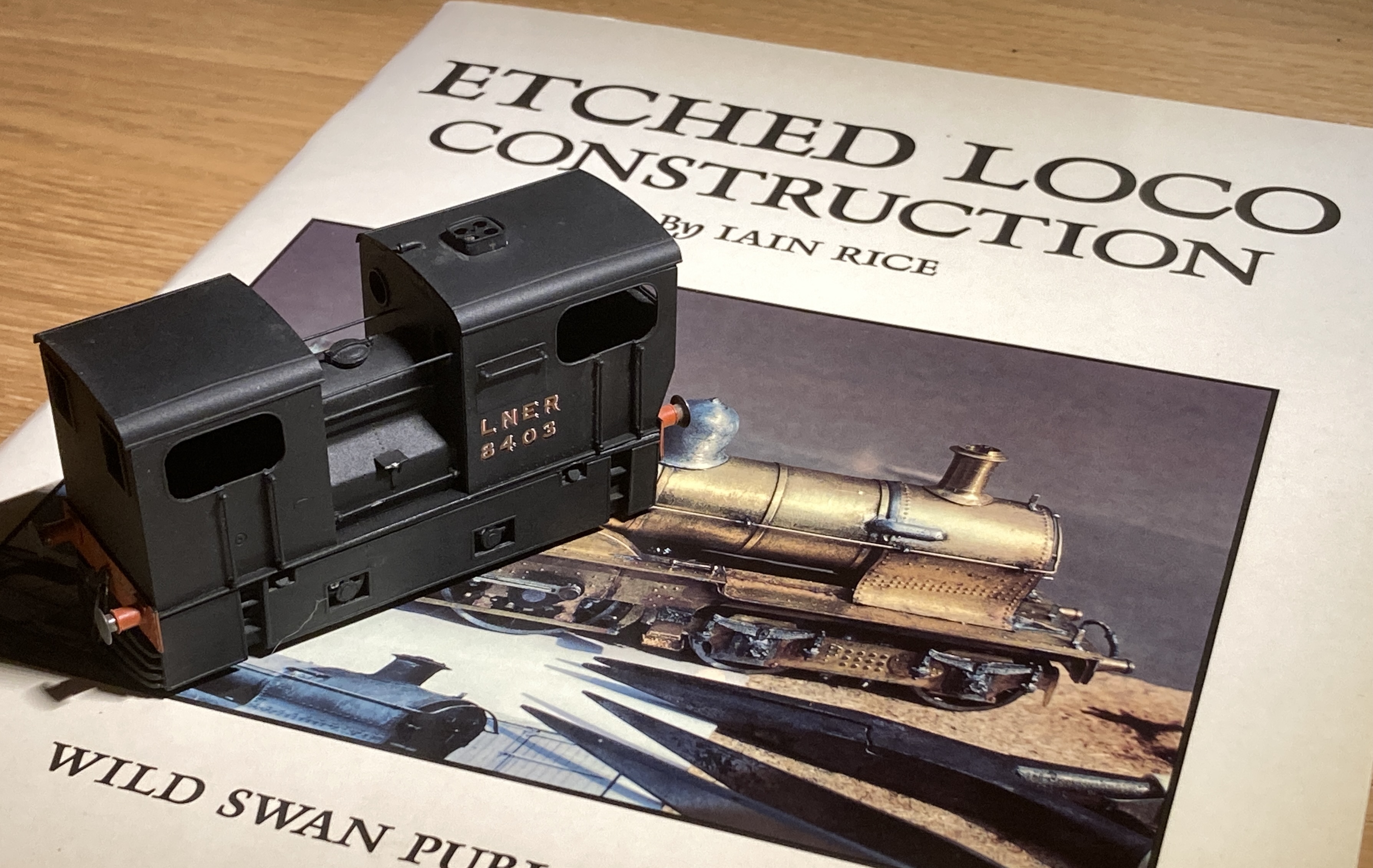
Etched Loco Construction Iain Rice

This weekend the hobby lost one of its greatest influencers, Iain Rice. So why might that be a motivation? Well Iain was a prolific writer and modeller across the hobby, not only here in the UK but its fair to say world wide too, and a good part of that without the internet. As I sit here in the man cave a quick look around, and I can see the clear influence he’s had on me, (and will continue to have) as a modeller, and to a degree writer.

Shelfie2

Just a glance at Shelfie2 above, or Albion Yard, Shelfie1, Shelfie3, Shelfie4 all have that unmistakeable influence running through their very core. I’ll return in the future to Iains writing and influences on me, and the hobby as it was I’d suggest the largest influence by one individual so far.

I don’t think that’s too big a claim to make, in a very media aware world the term influencer is often seen comparatively as a short lived, bright burning light, and perhaps of little significance. The header image above in a single shot tells part of my story and Iains influence on it. The locomotive is an etched kit by Impetus from the early 90’s. The book, written by Iain for Wild Swan, (another hobby legacy connection) gave me access to skills, written and illustrated in an engaging way, so much so that I wanted get stuck in. Motivation, pure and simple! I did get motivated, driven by wanting to achieve similar results, the locomotive is the first etched kit I ever completed, its got that light railway Rice connection too. Without the books, magazine articles and talking to him at various shows, my journey would have take a very different path.

This post isn’t about me though, it’s just a quick few thoughts on a really nice guy I had the pleasure to know a little, and was humbled when he told me he read the blog, and included a small piece on Albion Yard’s presentation in one of his books. I’d spoken to him early this year and knew he wasn’t well, but he’d agreed to have discussions about a writing article that unfortunately won’t happen. He leaves a massive gap in the hobby, but an even bigger positive legacy that has changed the hobby by far for the better.

I hope I can speak for many of you readers and followers of the blog when we recognise our loss in the hobby of course is nothing compared to that of his family and closest friends, and to offer our collective deepest sympathies and best wishes at this very difficult time.

And finally, for Iain, thank you.

Posted in accurascale, Bachmann, blog, British Rail, Cameo, Cameo layout, DC, DCC, Eighties, epitaph, finescale, heljan, hero, history, ho scale, hobbies, Hobby, iain rice, Inspiration, Layout, layout design, life, man cave, media, model, Model Railroad, Model Railway, Model Railway Journal, Modelling, Modelu, monday motivation, motivation monday, n gauge, Narrow Gauge, news, O Gauge, o scale, obituary, OO, peco, prototype, railroad, railway, Railway Modeller, realism, research, scale, scale modelling, scaleforum, shelfie, skill, toy train, track, track plans, TT Gauge, Uncategorized, wild swan | 4 Comments

Brutal Sunday

Ratio 554 ARP Signal Box

Well it’s a Sunday, and this is brutal. I’m putting together Ratio’s ARP signal box kit, and it’s brutal! Not the kit as such, though there are some ‘clunky’ elements to it, but the core prototype design, as a building it’s savage!

Ratio 554 ARP components

Just looking at the components hammers home the functionality of the prototype design. King Charles III, previously known as The Prince of Wales, referred to a proposal for the National Gallery as ‘What is proposed is like a monstrous carbuncle on the face of a much loved and elegant friend’. And that was for a sympathetic, allegedly, makeover of the National Gallery.

Peco LK-201 Highland Signal Box

The previous signal box I built was the Peco Highland Signal box above, a lovely laser cut wooden box with plenty of natural charm.

When you place the two next to one another, you can see the pure utilitarian function of the ARP box, and whilst not a change to an existing building as the National Gallery proposal was, it’s hard not to perhaps consider these as carbuncles of signal box design!

Ratio 554 ARP Signal Box

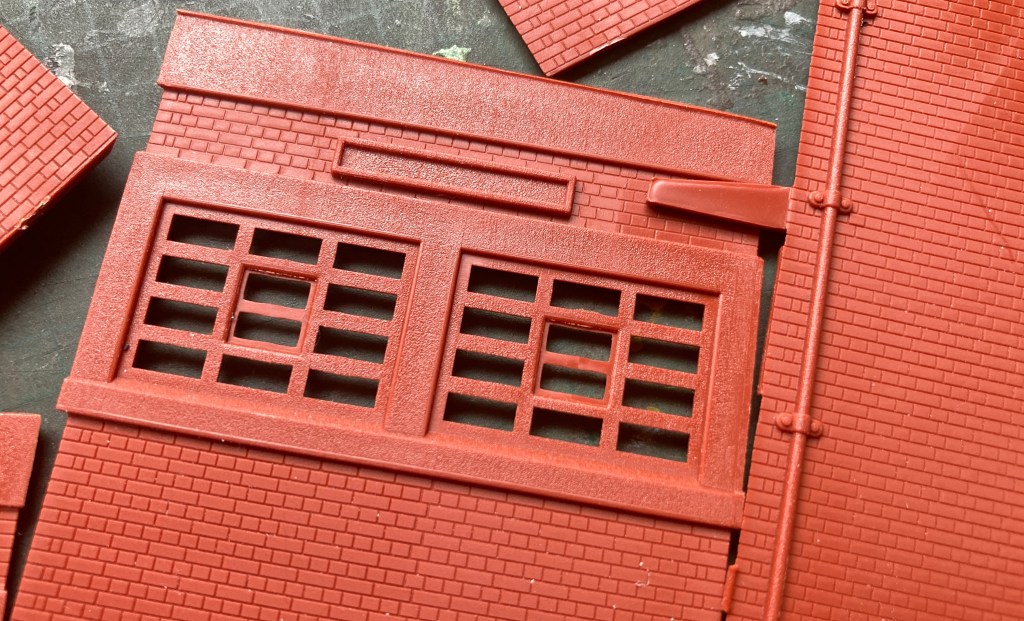
It’s clear from the kit that Ratio have done two things, designed a simple kit to assemble, and used the utilitarian nature of the ARP design to reduce the number of components. The frustration of this kit for me is the windows, and in particular the framework. It’s way too thick. There’s some good illustrations here of ARP design signal boxes, and it’s easy to see the difference between the kit windows and the prototype. Clearly being able to mould the walks and windows as one piece is a good cost saver for Ratio, but is has compromised the authenticity and look of the model.

As you can see from the image above I’ve taken a brave pill and removed the framing, and will subsequently work a way to replace the frames with a finer looking framework. It’s a sort of modification that would suit an etched replacement really well. The other element which let’s the model down is the signal box name boards. Both are integral mouldings on the end walls, thus meaning removal for longer or shorter location names. The chimney position looks odd too being at the front of the box rather than at the back. That’s something I’ll look at prior to final fix.

Ratio 554 EP model

What is provided matches the engineering prototype really well, see above and as mentioned it’s a simple kit, seven components make up the core structure, and a further twenty or so complete it! Having been critical of a couple of areas, it’s worth mentioning that the overall capture is excellent, and the brickwork renditioning is second to none. This one will repay careful painting in due course.

Because this is a man cave build, I’ve obviously not followed the instructions. This is because the new windows will need quite a bit of fettling to get them right. And subtly changing the build sequence will accommodate that.

Putting this together in a way to gauge the volume and suitability for Shelfie 3, I’m struck by the physical size of this box, it’s actually quite a large structure.

So that’s the core structure loosely assembled and in less than an hour. The whole kit (unmodified), I reckon would be an evenings work, plus painting time, for a beginner, that’s a good start!

My hope is that taking inspiration from the likes of Geoff Taylor, and Geoff Kent with their undoubted abilities to capture all sorts of architecture, I might get a far better looking signal box at end of play. Microstrip and Limonene, game on!

Posted in Airfix, architecture, Bachmann, blog, British Rail, Brutal, critic, Great Western, gwr, history, HO, ho scale, Hornby, Industrial, King Charles, King Charles III, Layout, layout design, LMS, LNER, man cave, model, Model Railroad, Model Railway, Modelling, n gauge, new release, O Gauge, o scale, OO, OO Gauge, peco, planning, Prince Charles, railway, Ratio, review, scale modelling, Scottish Region, shelfie, shelfie3, signal, signal box, signalling, Southern, toy train, Uncategorized, world war two | 3 Comments

Wordless Wednesday (keep him quiet)

These will keep me quiet…
Posted in accurascale, Bachmann, blog, DC, DCC, finescale, freelance, Hattons, heljan, HO, ho scale, Hobby, Hornby, Industrial, Inspiration, Layout, man cave, media, model, Model Railroad, Model Railway, Model Railway Journal, Modelling, n gauge, new release, O Gauge, o scale, OO, OO Gauge, peco, planet industrials, product news, railroad, railway, Rapido Trains, scale modelling, shelfie, toy train, train set, wordless wednesday | Leave a comment

Wordless Wednesday Shelfie 3

Shelfie 3
Posted in accurascale, Bachmann, black and white, blog, Branch Line, British Rail, Cameo, Cameo layout, DC, DCC, DMU, finescale, heljan, ho scale, hobbies, Hobby, Hornby, Inspiration, iphoneography, Layout, layout design, man cave, model photography, Model Railroad, Model Railway, n gauge, O Gauge, o scale, OO Gauge, peco, peco bullhead, railroad, railway, scale modelling, shelfie, shelfie3, toy train, trainset, wordless wednesday | Leave a comment

Wordless Wednesday IL76

Silk Way IL76
Posted in aviation, blogger, Doncaster, flight, flying, great britain, life, travel, Uncategorized, Yorkshire | Leave a comment

Larkrail Exhibition 2022

Larkrail 2022

It’s a week today that Shelfie2 will go to its first exhibition in completed state. Larkrail is a really nice one day show at the eastern end of Bath. It’s a show I look forward to, quite the trip for me, but always worth it. If you’re in the area do put it in the diary, you won’t be disappointed, particularly of you like light and branch line railways.

Shelfie 2

See you there!

Posted in accurascale, Bachmann, Branch Line, British Rail, Cameo, Cameo layout, DC, DCC, dcc sound, Eighties, Exhibition, finescale, Hattons, heljan, HO, ho scale, hobbies, Hobby, Hornby, Layout, layout design, LED, LED Lighting, model, model photography, Model Railroad, Model Railway, Modelling, n gauge, Narrow Gauge, O Gauge, obituary, OO, OO Gauge, peco, peco bullhead, prototype, railroad, railway, realism, scale, scale modelling, shelfie, shelfie2, toy train, track plans, train show, trees, Uncategorized | Leave a comment

Throwback Thursday

Not Dursley …

This came up on a Facebook memory thing, and being eight years old it intrigued me to re-read it. I did, and it brought a wry grin, (or it may have been wind), to my face.

Peco Code 75 Bullhead Track

In the above post, I mused about the introduction of OO finescale track, there was much foaming going on about what and who should produce it, without any co-ordinated approach on the way forward. Step forward eight (OMG!) years and today we have the Peco Bullhead range, with the recent introduction of their crossings and slips. I’m pretty certain that the range was already in development at the time of the original posting, allowing for normal lead times too.

Shelfie 2

I thought in the above post that before we saw ‘finescale’ OO track I’d have built a model of Dursley. Well…. Shelfie 2 sits upon the baseboard that was earmarked for Dursley, but it does have some of the Peco Bullhead track on it! However Shelfie 3 in the header picture uses the new ‘finescale’ track entirely.

Peco TT Track

By bizarre coincidence while talking about the footprint on Shelfie1 in that post, I mentioned TT, and this month in the man cave, there’s TT track! On the interweb there was and is plenty of comments about how this TT should, or shouldn’t be done at all, parallels with the 2014 comments about finescale OO track.

The world moves in mysterious ways!

Posted in accurascale, Bachmann, baseboards, blog, Cameo, Cameo layout, DC, DCC, finescale, Hattons, heljan, HO, ho scale, hobbies, Hobby, Hornby, Layout, layout design, man cave, mancave, model, Model Railroad, Model Railway, Modelling, n gauge, Narrow Gauge, O Gauge, o scale, OO, OO Gauge, peco, peco bullhead, Peco TT, railroad, railway, scale modelling, shelfie, shelfie1, shelfie2, shelfie3, throwback thursday, thursday throwback, toy train, TT, TT Gauge, Uncategorized | Leave a comment

TT120 Tuesday Tracks

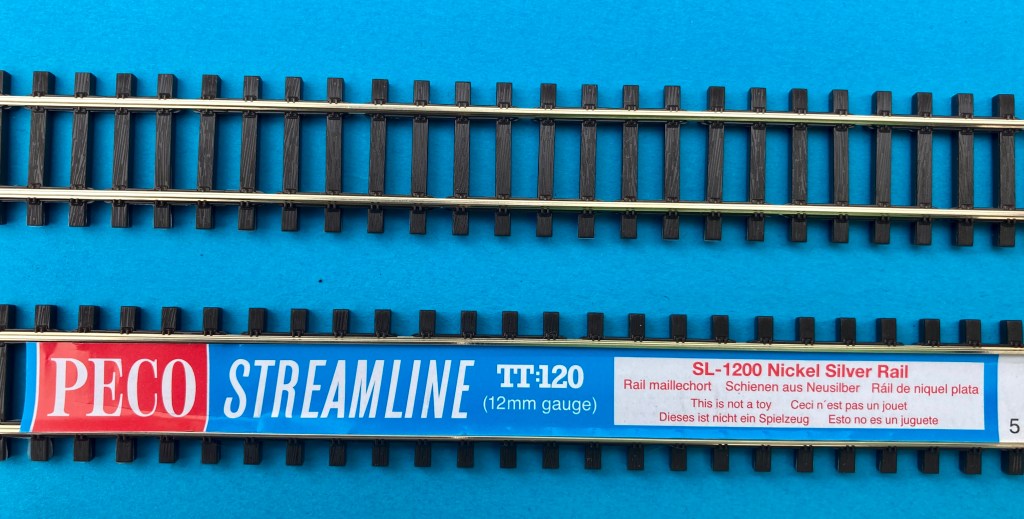
Peco TT SL-1200 Flexible Track

This probably looks like a boring old bit of flexitrack on first glance for Peco’s new TT track range, and yup, it’s 12mm gauge flexible track. End of story surely! However it does deserve a closer look.

Peco TT SL-1200 Flexible Track

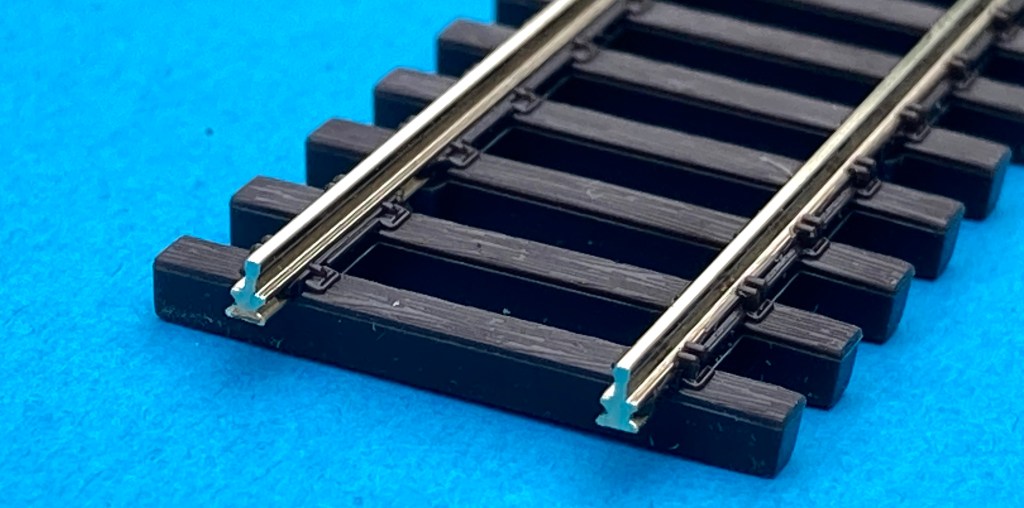
There are two things immediately of note, the shape of the rail ends, (above), and the rigidity of the track. The rail is Peco’s Code 55 section. This in 1:120 (TT scale), is equivalent to a typical British Rail 113lb flat bottom rail.

Peco TT SL-1200 Flexible Track

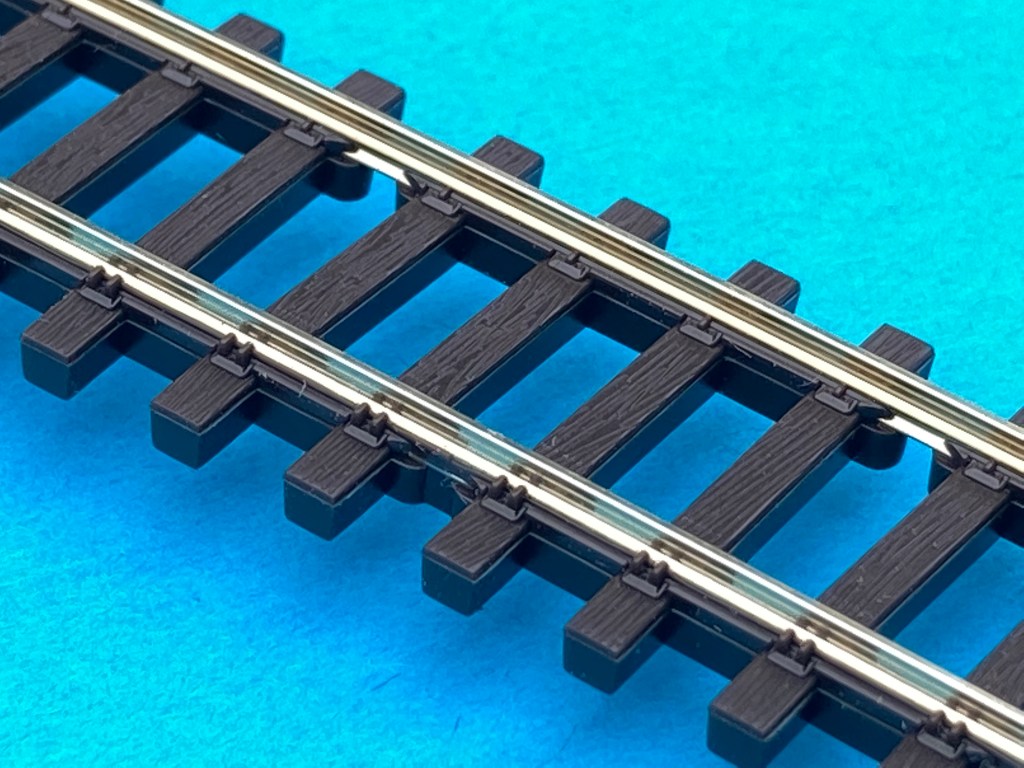
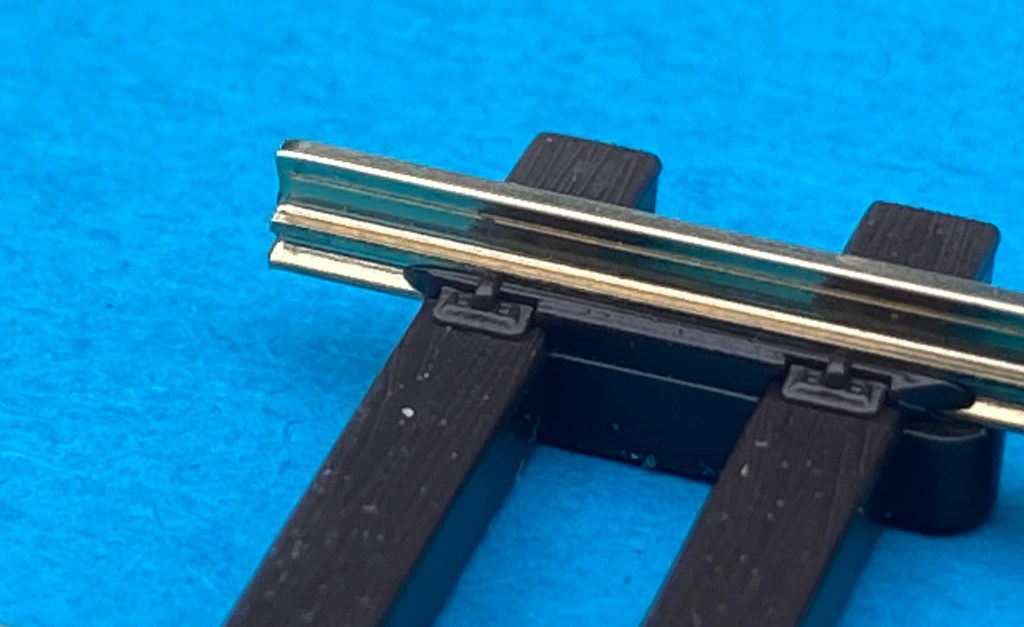
The track represents wooden sleeper track with BR1 rail fixings, for both the flexible track and points. The same rail section is used in the points.

Peco TT SL-1200 Flexitrack

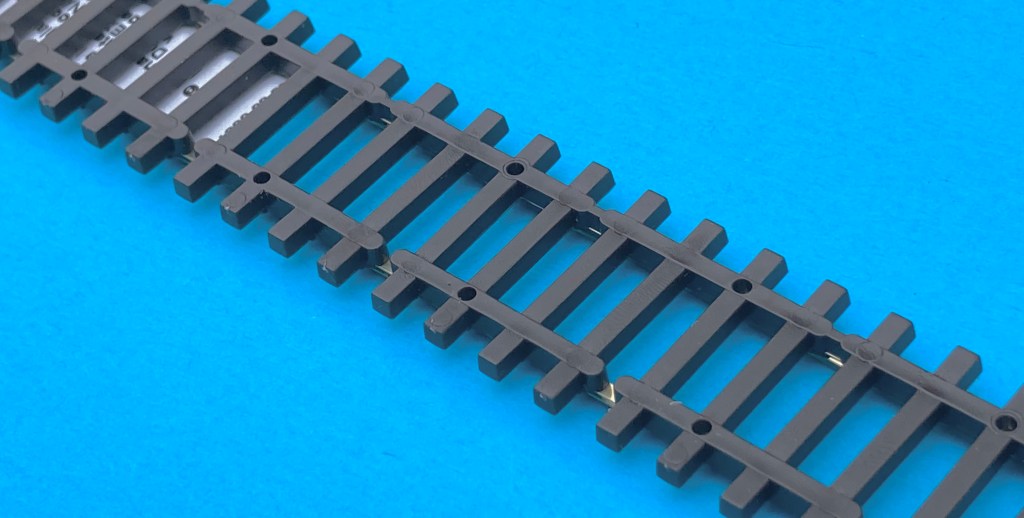
The rail has a web at its base that allows it to be threaded through the sleepers giving a firm foundation for the tracks.

Peco TT SL-1200 Flexible Track

The key reason for the track rigidity is apparent once it’s turned over. Not only is the rail itself quite rigid, but the webbing underneath the sleepers is rigid on one side. The opposite side has breaks every four sleepers. I do like this idea, it’ll make laying straight track easier, with no degradation of the practicality of cutting webs to make a curved section. One thing I did find interesting was that there are no blind holes in the flexi track base for drilling track pins, but there are in the points.

Peco TT SL-1208 Joiner Sleepers

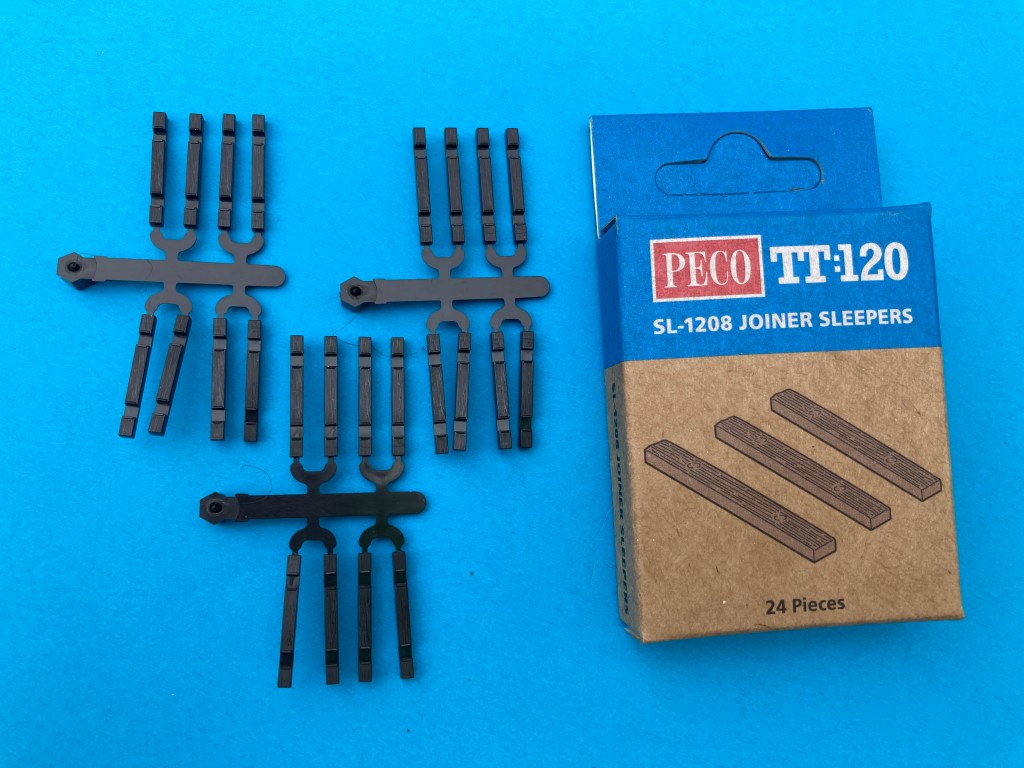
Rail joiners for this track are Peco SL-310, already in the Peco range, and to assist joining sections, spare sleepers are also available.

Peco TT SL-1240 Buffer Stops

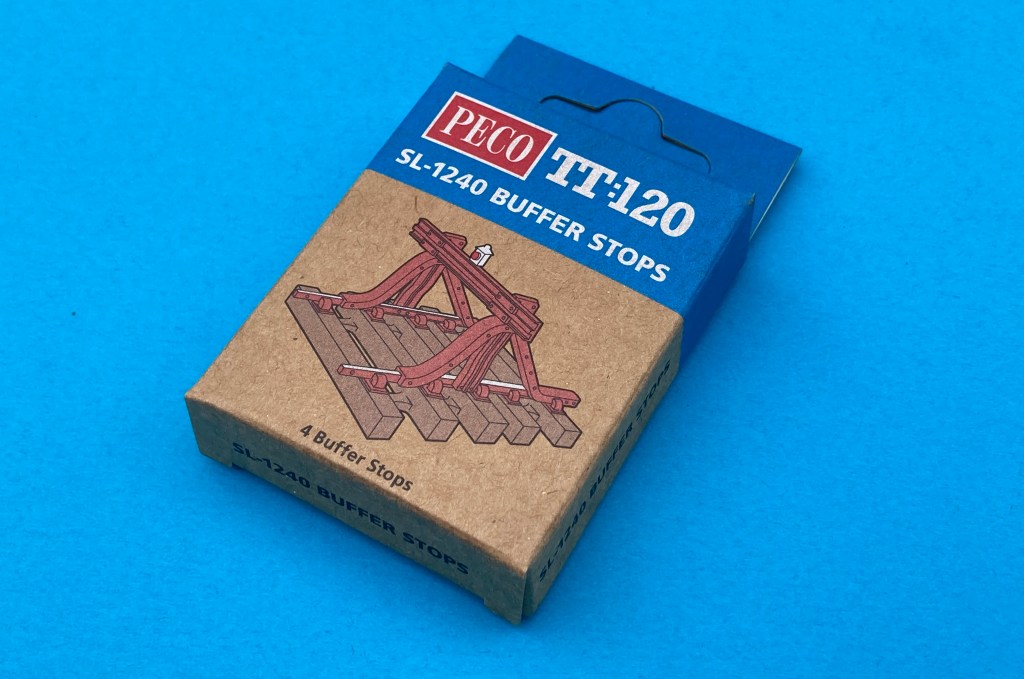
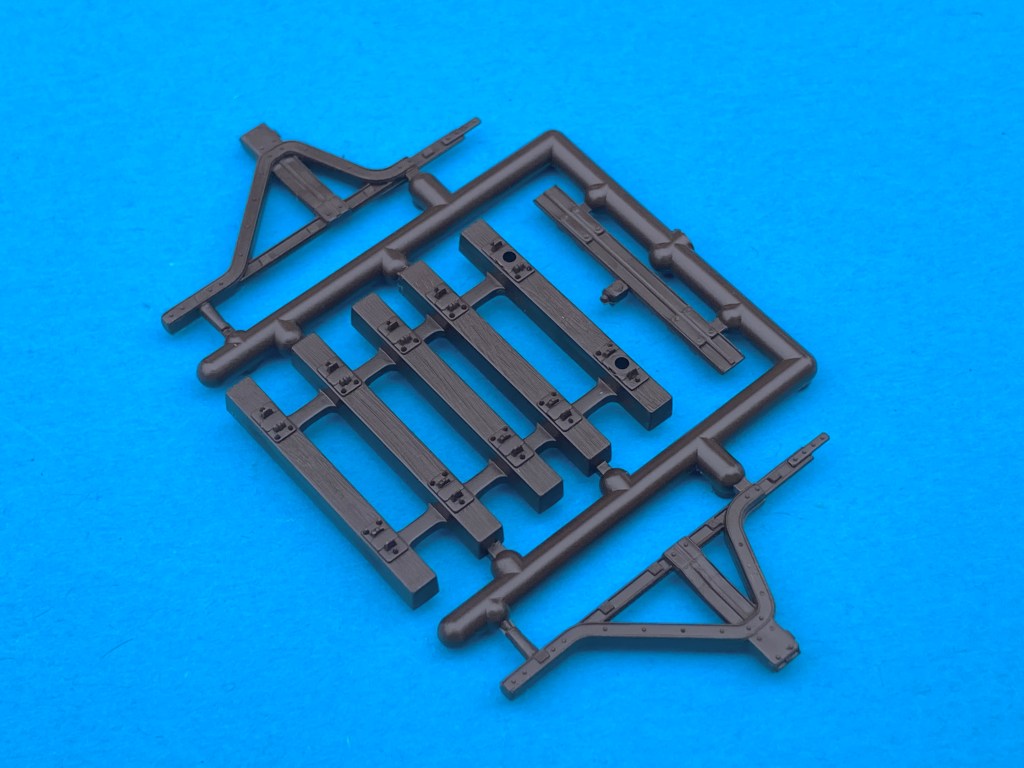
For the ends of sidings Peco provide a simple four part plastic kit for buffer stops in a bullhead rail section.

Peco TT SL-1240 Buffer Stops kit
Peco TT SL-1240 Buffer Stops

This kit took a couple of minutes to put together, fixed with polystyrene cement. The sleeper depth automatically allows alignment with the flexible track and points.

In the next TT post I’ll take a more detailed look at the Unifrog medium left and right hand points, these few weeks a bit of a track overdose, not only do I have the TT range to look at there’s more for the OO bullhead range, and O gauge set track to try out!

Posted in accurascale, Bachmann, blog, Branch Line, British Rail, Cameo, Cameo layout, DC, DCC, dcc sound, finescale, heljan, HO, ho scale, hobbies, Hobby, Hornby, model, Model Railroad, Model Railway, Modelling, n gauge, Narrow Gauge, news, O Gauge, o scale, OO, OO Gauge, peco, Peco TT, product news, railway, Rapido Trains, realism, review, scale, scale modelling, shelfie, toy train, track, track plans, trainset, TT, TT Gauge, Uncategorized | Leave a comment